Quotessence
Home / Quotes / Quote by Ambrose

Quote by Ambrose

“We must follow the ways of the Lord, and take heed to our own ways, lest they lead us into sin. One can take heed if one is not hasty in speaking. The law says: 'Hear, O Israel, the Lord your God' (Dt. 6:4). It said not: 'Speak,' but 'Hear.' Eve fell because she said to the man what she had not heard from the Lord her God. The first word from God says to you: Hear!”

Quote by Ambrose

Work

The Sacred Writings of St. Ambrose

The Sacred Writings of St. Ambrose encompasses a variety of texts, including sermons, letters, and treatises, reflecting the teachings and insights of the fourth-century bishop of Milan. These writings delve into topics such as the nature of God, the Trinity, and the role of the church in society. more

Author
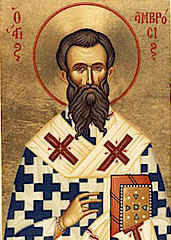
Ambrose
Ambrose

St. Ambrose, born in 337 and died on April 4, 397, was a significant figure in ancient Christianity, revered as a saint. During his tenure as the bishop of Milan, he was known for his exceptional preaching and theological contributions. Ambrose, who had a background in rhetoric and philosophy, had a profound impact on political, philosophical, and theological domains. His teachings and writings continue to be influential in the study of Christian doctrine and theology. more

You May Also Like

“How do we receive the highest mystery of Divine love to us ? the mystery of the Christian faith? With our mind, heart and life; with our free will? Are all the three powers of our souls penetrated by holy faith, as were the souls of the saints? The kingdom of heaven 'is like leaven, which a woman took and hid in three measures of meal till the whole was leavened' (Lk. 13:21). The three measures are the three powers of the soul.”

“Total surrender to the will of God actually is sacrificing oneself as a burnt offering to God. The proof of this state is dying to oneself, - to one's own opinions, wishes and feelings or tastes, in order to live by Divine intellect, in conformity with the Divine will and in partaking of God. In the forefront of this endeavor is our Lord and Savior. He surrendered the whole of Himself to God the Father, and us in Himself, 'For we are members of His body, of His flesh, and of His bones' (Eph. 5:30). So let us hasten in His footsteps?”

“The Lord came to send fire upon the earth (cf. Lk. 12:49), and through participation in this fire He makes divine not just the human substance which He assumed for our sake, but every person who is found worthy of communion with Him.”

“Do not desert a friend in time of need, nor forsake him nor fail him, for friendship is the support of life. Let us then bear our burdens as the Apostle has taught (cf. Gal. 6:2): for he spoke to those whom the charity of the same one body had embraced together. If friends in prosperity help friends, why do they not also in times of adversity offer their support? Let us aid by giving counsel, let us offer our best endeavors, let us sympathize with them with all our heart.”

“... at the beginning of the human race the woman was made of a rib taken from the side of the man while he slept; for it seemed fit that even then Christ and His Church should be foreshadowed in this event. For that sleep of the man was the death of Christ, whose side, as He hung lifeless upon the Cross, was pierced with a spear, and there flowed from it blood and water, and these we know to be the sacraments by which the Church is built up.”

“... when death has been brought upon a saint, we ought not to think that an evil has happened to him but a thing indifferent; which is an evil to a wicked man, while to the good it is rest and freedom from evils. 'For death is rest to a man whose way is hidden' (Job 3:23 LXX). And so a good man does not suffer any loss from it.”

“When you see your body wasted away through sickness, do not murmur against God, but say: 'The Lord gave, and the Lord has taken away; blessed be the name of the Lord' (Job 1:21). You are accustomed to look upon your body as upon your own inalienable property, but that is quite wrong, because your body is God's edifice.”

“Our Lord humbled without humiliation His lofty station which yet could not be humbled, and condescends to His servants, with a condescension ineffable and incomprehensible. God being perfect becomes perfect man, and brings to perfection the newest of all new things (cf. Eccles 1:10), the only new thing under the sun, through which the boundless might of God is manifested. For what greater thing is there than that God should become man?”