Quotessence
Home / Quotes / Quote by Justus von Liebig

Quote by Justus von Liebig

“What struck me most in England was the perception that only those works which have a practical tendency awake attention and command respect, while the purely scientific, which possess far greater merit are almost unknown. And yet the latter are the proper source from which the others flow. Practice alone can never lead to the discovery of a truth or a principle. In Germany it is quite the contrary. Here in the eyes of scientific men no value, or at least but a trifling one, is placed upon the practical results. The enrichment of science is alone considered worthy attention.”

Quote by Justus von Liebig

Author
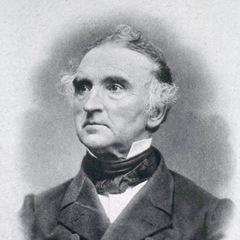
Justus von Liebig
Justus von Liebig

Justus von Liebig, a German chemist born on May 12, 1803, and died on April 18, 1873, is considered one of the founders of organic chemistry. He made significant contributions to the development of agricultural chemistry and food science. more

You May Also Like

“Yet as I cast my eye over the whole course of science I behold instances of false science, even more pretentious and popular than that of Einstein gradually fading into ineptitude under the searchlight; and I have no doubt that there will arise a new generation who will look with a wonder and amazement, deeper than now accompany Einstein, at our galaxy of thinkers, men of science, popular critics, authoritative professors and witty dramatists, who have been satisfied to waive their common sense in view of Einstein's absurdities.”

“With all reserve we advance the view that a supernova represents the transition of an ordinary star into a neutron star consisting mainly of neutrons. Such a star may possess a very small radius and an extremely high density. As neutrons can be packed much more closely than ordinary nuclei and electrons, the gravitational packing energy in a cold neutron star may become very large, and under certain conditions may far exceed the ordinary nuclear packing fractions.”

“In the field one has to face a chaos of facts, some of which are so small that they seem insignificant; others loom so large that they are hard to encompass with one synthetic glance. But in this crude form they are not scientific facts at all; they are absolutely elusive, and can be fixed only by interpretation, by seeing them sub specie aeternitatis, by grasping what is essential in them and fixing this. Only laws and generalizations are scientific facts, and field work consists only and exclusively in the interpretation of the chaotic social reality, in subordinating it to general rules.”