Quotessence
Home / Quotes / Quote by Thomas Paine

Quote by Thomas Paine

“There are a set of men who go about making purchases upon credit, and buying estates they have not wherewithal to pay for; and having done this, their next step is to fill the newspapers with paragraphs of the scarcity of money and the necessity of a paper emission, then to have a legal tender under the pretense of supporting its credit, and when out, to depreciate it as fast as they can, get a deal of it for a little price, and cheat their creditors; and this is the concise history of paper money schemes.”

Quote by Thomas Paine

Work

Brief sketch of the life of Thomas Paine. Common sense. Epistle to Quakers. The crisis. Public good. Letter to the Abbe Raynal. Dissertations on government, the affairs of the bank, and paper money. Miscellaneous

The book features Paine's influential essays and letters, including his seminal work 'Common Sense,' which played a significant role in the American Revolution. It also includes his 'Brief sketch of the life of Thomas Paine,' 'Epistle to Quakers,' 'The crisis,' 'Public good,' 'Letter to the Abbe Raynal,' and 'Dissertations on government, the affairs of the bank, and paper money.' These writings showcase Paine's ideas on governance, economics, and social issues. more

Author
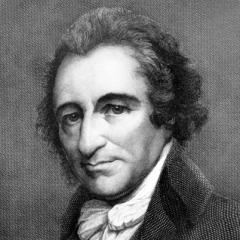
Thomas Paine
Thomas Paine

Thomas Paine, born on February 9, 1737, and died on June 8, 1809, was a prominent American writer, political figure, and philosopher during the American Revolutionary War. He is renowned for his radical democratic ideas and his contributions to the American independence movement. more

You May Also Like

“One of the evils of paper money is that it turns the whole country into stock jobbers. The precariousness of its value and the uncertainty of its fate continually operate, night and day, to produce this destructive effect. Having no real value in itself it depends for support upon accident, caprice, and party; and as it is the interest of some to depreciate and of others to raise its value, there is a continual invention going on that destroys the morals of the country.”

“Money, when considered as the fruit of many years' industry, as the reward of labor, sweat and toil, as the widow's dowry and children's portion, and as the means of procuring the necessaries and alleviating the afflictions of life, and making old age a scene of rest, has something in it sacred that is not to be sported with, or trusted to the airy bubble of paper currency.”

“If the government were obliged to come to the people for money instead of vice-versa, the people would keep government under control and operate their economy satisfactorily with prosperity and peace resulting. The peoples of the nations do not make war. For them peace is the natural and permanent order. Wars are planned and perpetrated by politicians and their diplomats; and the money power of government is the means by which the people are maneuvered into wars.”

“Money is an instrumentality of the profit motive and must be issued and backed only by private enterprisers. Economic and political perversities are inescapable while government is admitted to money power. Since all national governments have, up to the present, been money issuing powers we may justly attribute all the economic and political ills of mankind to this single error.”

“When government is invested with money power it rises above the citizen and under the profession of protecting him may actually constitute the greatest threat to his well-being and safety. The power which control of the money system gives to government to interfere in and direct and even take the life of the individual should not exist on this earth. No man or group of men is warranted in holding this terrible power over fellow men.”

“As long as we cling to the superstition that we must look to government for money supply, instead of requiring it to look to us, just so long must we remain the subjects of government and it is vain to follow this or that policy or party or ism in the hope of salvation. We can control government and our own destiny only through our money power and until we exert that power it is useless for us to debate the pros and cons of political programs.”