Quotessence
Home / Quotes / Quote by Clement of Alexandria

Quote by Clement of Alexandria

Work

Delphi Complete Works of Clement of Alexandria (Illustrated)

The Delphi Complete Works of Clement of Alexandria (Illustrated) is a scholarly compilation of the writings of Clement of Alexandria, a significant figure in the early Christian church. The collection includes his major works, such as "The Stromata" and "The Exhortation to the Heathen," which explore Christian doctrine, ethics, and apologetics. The illustrated format provides additional context and insight into the historical and cultural background of Clement's work, making it a valuable resource for scholars and students of early Christianity. more

Author
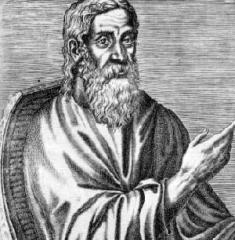
Clement of Alexandria

Clement of Alexandria was a prominent theologian in the 2nd to 3rd centuries AD, known as one of the founders of the Alexandrian Church. His writings had a profound impact on the development of Christian theology, particularly his works 'The Stromata' and 'Against the Gnostics'. more

You May Also Like

“He who prohibited the making of a graven image would never himself have made an image in the likeness of holy things [i.e., by creating an image of them here on earth]. Nor is there at all any composite thing or creature endowed with sensation [made by God here on earth] like those in heaven. But the face is a symbol of the rational soul, the wings are the lofty ministers and energies of powers right and left, and the voice is delightful glory in endless contemplation.”

“If we refuse our homage to statues and frigid images, the very counterpart of their dead originals, with which hawks, and mice, and spiders are so well acquainted, does it not merit praise instead of penalty [Christians were punished for not worshiping Roman gods] that we have rejected what we have come to see is error? We cannot surely be made out to injure those whom we are certain are nonentities. What does not exist is in its nonexistence secure from suffering.”

“Enoch predicted that "the demons and the spirits of the angelic apostates would turn into idolatry all the elements, all the adornment of the universe, and all things contained in the heaven, the sea, and the earth, that they might be consecrated as God in opposition to God." All things, therefore, does human error worship, except the Founder of all himself. The images of those things are idols; the consecration of the images is idolatry.”

“Offerings to propitiate the dead then were regarded as belonging to the class of funeral sacrifices, and these are idolatry. Idolatry, in fact, is a sort of homage to the departed, the one as well as the other is a service to dead men. Moreover, demons dwell in the images of the dead. ... this sort of exhibition has passed from honors of the dead to honors of the living; I mean, to quaestorships [financial overseers]and magistractes, to priestly offices of different kinds. Yet, since idolatry still cleaves to the dignity's name, whatever is done in its name partakes of its impurity.”

“Among many other weighty objections to the Measure, it has been suggested, that it has a tendency to introduce religious disputes into the Army, which above all things should be avoided, and in many instances would compel men to a mode of Worship which they do not profess.”

“Government being, among other purposes, instituted to protect the consciences of men from oppression, it certainly is the duty of Rulers, not only to abstain from it themselves, but according to their stations, to prevent it in others.”