“The organized lying practiced by totalitarian states is not, as is sometimes claimed, a temporary expedient of the same nature as military deception. It is something integral to totalitarianism, something that would still continue even if concentration camps and secret police forces had ceased to be necessary. Among intelligent Communists there is an underground legend to the effect that although the Russian government is obliged now to deal in lying propaganda, frame-up trials, and so forth, it is secretly recording the true facts and will publish them at some future time. We can, I believe, be quite certain that this is not the case, because the mentality implied by such an action is that of a liberal historian who believes that the past cannot be altered and that a correct knowledge of history is valuable as a matter of course. From the totalitarian point of view history is something to be created rather than learned. A totalitarian state is in effect a theocracy, and its ruling caste, in order to keep its position, has to be thought of as infallible. But since, in practice, no one is infallible, it is frequently necessary to rearrange past events in order to show that this or that mistake was not made, or that this or that imaginary triumph actually happened. Then again, every major change in policy demands a corresponding change of doctrine and a revelation of prominent historical figures. This kind of thing happens everywhere, but is clearly likelier to lead to outright falsification in societies where only one opinion is permissible at any given moment. Totalitarianism demands, in fact, the continuous alteration of the past, and in the long run probably demands a disbelief in the very existence of objective truth. The friends of totalitarianism in this country usually tend to argue that since absolute truth is not attainable, a big lie is no worse than a little lie. It is pointed out that all historical records are biased and inaccurate, or on the other hand, that modern physics has proven that what seems to us the real world is an illusion, so that to believe in the evidence of one’s senses is simply vulgar philistinism. A totalitarian society which succeeded in perpetuating itself would probably set up a schizophrenic system of thought, in which the laws of common sense held good in everyday life and in certain exact sciences, but could be disregarded by the politician, the historian, and the sociologist.”
Quote by George Orwell
Work
The Prevention of Literature
Browse quotes and source details for this work. more
Author
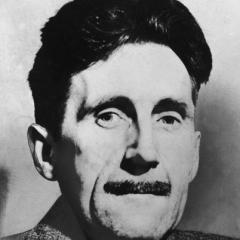
George Orwell
George Orwell, born Eric Arthur Blair, was a British novelist and political critic. Known for his sharp social criticism and profound insights into totalitarianism, Orwell is best remembered for his novels '1984' and 'Animal Farm', which remain influential to this day. more
You May Also Like
Source: Be A Good Human
Source: Find A Cause Outside Yourself: Sermon of Sustainability
Source: Worth the Risk: How to Microdose Bravery to Grow Resilience, Connect More, and Offer Yourself to the World
Source: Worth the Risk: How to Microdose Bravery to Grow Resilience, Connect More, and Offer Yourself to the World
Source: Worth the Risk: How to Microdose Bravery to Grow Resilience, Connect More, and Offer Yourself to the World
Source: Worth the Risk: How to Microdose Bravery to Grow Resilience, Connect More, and Offer Yourself to the World
Source: The War of the Mind: Understanding Inflation and Alienation
“Co-existing is like interacting and living with beings of the other dimension.”
Source: The Art of Learning a Foreign Language: 25 Things I Wish They Told Me