Quotessence
Home / Quotes / Quote by Hammurabi

Quote by Hammurabi

“If a chieftain or a man leave his house, garden, and field and hires it out, and some one else takes possession of his house, garden, and field and uses it for three years; if the first owner return and claims his house, garden, and field, it shall not be given to him, but he who has taken possession of it and used it shall continue to use it.”

Quote by Hammurabi

Author
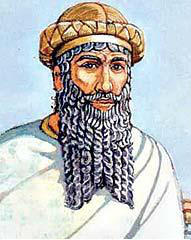
Hammurabi
Hammurabi

Hammurabi was the sixth king of the Babylonian Empire, known for being one of the first to codify laws into written form. During his reign, the Babylonian Empire reached its peak of prosperity. The exact dates of his birth and death are unknown. more

You May Also Like

“So erst the Sage [Pythagoras] with scientific truth In Grecian temples taught the attentive youth; With ceaseless change how restless atoms pass From life to life, a transmigrating mass; How the same organs, which to-day compose The poisonous henbane, or the fragrant rose, May with to-morrow's sun new forms compile, Frown in the Hero, in the Beauty smile. Whence drew the enlighten'd Sage the moral plan, That man should ever be the friend of man; Should eye with tenderness all living forms, His brother-emmets, and his sister-worms.”

“I am sorry the infernal Divinities, who visit mankind with diseases, and are therefore at perpetual war with Doctors, should have prevented my seeing all you great Men at Soho to-day-Lord! what inventions, what wit, what rhetoric, metaphysical, mechanical and pyrotecnical, will be on the wing, bandy'd like a shuttlecock from one to another of your troop of philosophers! while poor I, I by myself I, imprizon'd in a post chaise, am joggled, and jostled, and bump'd, and bruised along the King's high road, to make war upon a pox or a fever!”

“But the idea of science and systematic knowledge is wanting to our whole instruction alike, and not only to that of our business class ... In nothing do England and the Continent at the present moment more strikingly differ than in the prominence which is now given to the idea of science there, and the neglect in which this idea still lies here; a neglect so great that we hardly even know the use of the word science in its strict sense, and only employ it in a secondary and incorrect sense.”

“The study of letters is the study of the operation of human force, of human freedom and activity; the study of nature is the study of the operation of non-human forces, of human limitation and passivity. The contemplation of human force and activity tends naturally to heighten our own force and activity; the contemplation of human limits and passivity tends rather to check it. Therefore the men who have had the humanistic training have played, and yet play, so prominent a part in human affairs, in spite of their prodigious ignorance of the universe.”