Quotessence
Home / Quotes / Quote by E. O. Wilson

Quote by E. O. Wilson

“It may be argued that to know one kind of beetle is to know them all. But a species is not like a molecule in a cloud of molecules-it is a unique population.”

Quote by E. O. Wilson

Author
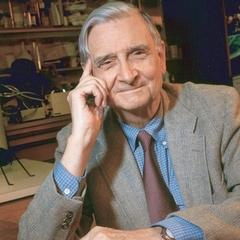
E. O. Wilson
E. O. Wilson

E. O. Wilson is a renowned American biologist, born on June 10, 1929. He has made significant contributions to the fields of entomology, sociobiology, and anthropology. Best known for his research on ants, he is often referred to as the 'father of ants'. His book 'Sociobiology: The New Science' had a profound impact on both biology and the social sciences. more

You May Also Like

“Let us suppose that we have laid on the table... [a] piece of glass... and let us homologize this glass to a whole order of plants or birds. Let us hit this glass a blow in such a manner as but to crack it up. The sectors circumscribed by cracks following the first blow may here be understood to represent families. Continuing, we may crack the glass into genera, species and subspecies to the point of finally having the upper right hand corner a piece about 4 inches square representing a sub-species.”

“I am much occupied with the investigation of the physical causes [of motions in the Solar System]. My aim in this is to show that the celestial machine is to be likened not to a divine organism but rather to a clockwork ... insofar as nearly all the manifold movements are carried out by means of a single, quite simple magnetic force. This physical conception is to be presented through calculation and geometry.”

“I know Teddy Kennedy had fun at the Democratic convention when he said that I said that trees and vegetation caused 80 percent of the air pollution in this country. ... Well, now he was a little wrong about what I said. I didn't say 80 percent. I said 92 percent-93 percent, pardon me. And I didn't say air pollution, I said oxides of nitrogen. Growing and decaying vegetation in this land are responsible for 93 percent of the oxides of nitrogen. ... If we are totally successful and can eliminate all the manmade oxides of nitrogen, we'll still have 93 percent as much as we have in the air today.”

“If two or more instances of the phenomenon under investigation have only one circumstance in common, the circumstance in which alone all the instances agree is the cause (or effect) of the given phenomenon.”

“In the patient who succumbed, the cause of death was evidently something which was not found in the patient who recovered; this something we must determine, and then we can act on the phenomena or recognize and foresee them accurately. But not by statistics shall we succeed in this; never have statistics taught anything, and never can they teach anything about the nature of the phenomenon.”

“Proof that a given condition always precedes or accompanies a phenomenon does not warrant concluding with certainty that a given condition is the immediate cause of that phenomenon. It must still be established that when this condition is removed, the phenomen will no longer appear.”