Quotessence
Home / Quotes / Quote by Claude Bernard

Quote by Claude Bernard

Work

An Introduction to the Study of Experimental Medicine

This book serves as a comprehensive guide to the field of experimental medicine, covering the historical context, fundamental concepts, and various experimental techniques. It explores the role of experimentation in advancing medical knowledge and the ethical considerations involved in conducting research on human subjects. more

Author
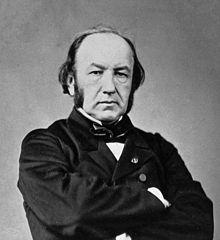
Claude Bernard
Claude Bernard

Claude Bernard was a French physiologist born on July 12, 1813, and died on February 10, 1878. He made significant contributions to the field of physiology, particularly in the study of the digestive system and the nervous system. more

You May Also Like

“The cause, then, philosophically speaking, is the sum total of the conditions, positive and negative, taken together; the whole of the contingencies of every description, which being realized, the consequent invariably follows.”

“The same thing may have all the kinds of causes, e.g. the moving cause of a house is the art or the builder, the final cause is the function it fulfils, the matter is earth and stones, and the form is the definitory formula.”

“The student of biology is often struck with the feeling that historians, when dealing with the rise and fall of nations, do not generally view the phenomena from a sufficiently high biological standpoint. To me, at least, they seem to attach too much importance to individual rulers and soldiers, and to particular wars, policies, religions, and customs; while at the same time they make little attempt to extract the fundamental causes of national success or failure.”

“We have no other notion of cause and effect, but that of certain objects, which have always conjoin'd together, and which in all past instances have been found inseparable. We cannot penetrate into the reason of the conjunction. We only observe the thing itself, and always find that from the constant conjunction the objects acquire an union in the imagination.”

“'Men die of the diseases which they have studied most,' remarked the surgeon, snipping off the end of a cigar with all his professional neatness and finish. 'It's as if the morbid condition was an evil creature which, when it found itself closely hunted, flew at the throat of its pursuer. If you worry the microbes too much they may worry you. I've seen cases of it, and not necessarily in microbic diseases either. There was, of course, the well-known instance of Liston and the aneurism; and a dozen others that I could mention.'”

“Atten. Pray of what disease did Mr. Badman die, for now I perceive we are come up to his death? Wise. I cannot so properly say that he died of one disease, for there were many that had consented, and laid their heads together to bring him to his end. He was dropsical, he was consumptive, he was surfeited, was gouty, and, as some say, he had a tang of the pox in his bowels. Yet the captain of all these men of death that came against him to take him away, was the consumption, for it was that that brought him down to the grave.”