Quotessence
Home / Quotes / Quote by Ernest Rutherford

Quote by Ernest Rutherford

“The year 1896 ... marked the beginning of what has been aptly termed the heroic age of Physical Science. Never before in the history of physics has there been witnessed such a period of intense activity when discoveries of fundamental importance have followed one another with such bewildering rapidity.”

Quote by Ernest Rutherford

Author
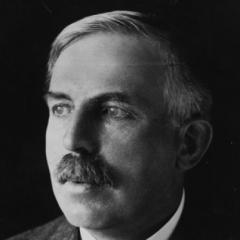
Ernest Rutherford
Ernest Rutherford

Ernest Rutherford, a British physicist, is renowned as the founder of nuclear physics. Born on August 30, 1871, in New Zealand, he passed away on October 19, 1937, in the United Kingdom. Rutherford made significant breakthroughs in the study of radioactivity, proposed the nuclear model of the atom, and discovered the proton. more

You May Also Like

“Walking the streets of Tokyo with Hawking in his wheelchair ... I felt as if I were taking a walk through Galilee with Jesus Christ [as] crowds of Japanese silently streamed after us, stretching out their hands to touch Hawking's wheelchair. ... The crowds had streamed after Einstein [on Einstein's visit to Japan in 1922] as they streamed after Hawking seventy years later. ... They showed exquisite choice in their heroes. ... Somehow they understood that Einstein and Hawking were not just great scientists, but great human beings.”

“Saint George killed the last dragon, and he was called a hero for it. I've never seen a dragon, and I wish he would have left at least one. Saint Patrick made a name for himself by running the snakes out of Ireland, leaving the place vulnerable to rodent infestation. This business of making saints out of men who exterminate their fellow creatures has got to stop. All I'm saying is, it's starting to get a little lonely up here at the top of the food chain.”

“The character truest to itself becomes eccentric rather than immovably centered, as Emerson defined the noble character of the hero. At the edge, the certainty of borders gives way. We are more subject to invasions, less able to mobilize defenses, less sure of who we really are, even as we may be perceived by others as a person of character. The dislocation of self from center to indefinite edge merges us more with the world, so that we can feel blest by everything.”

“I suspect it was...the old story of the implacable necessity of a man having honour within his own natural spirit. A man cannot live and temper his mettle without such honour. There is deep in him a sense of the heroic quest; and our modern way of life, with its emphasis on security, its distrust of the unknown and its elevation of abstract collective values has repressed the heroic impulse to a degree that may produce the most dangerous consequences.”