Quotessence
Home / Quotes / Quote by Richard P. Feynman

Quote by Richard P. Feynman

“It is the facts that matter, not the proofs. Physics can progress without the proofs, but we can't go on without the facts ... if the facts are right, then the proofs are a matter of playing around with the algebra correctly.”

Quote by Richard P. Feynman

Author
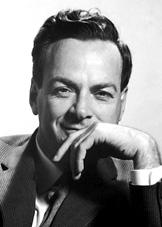
Richard P. Feynman
Richard P. Feynman

Richard P. Feynman was a renowned theoretical physicist known for his contributions to quantum mechanics and quantum electrodynamics. He was also an exceptional physicist in the field of physics education, with popular science books like 'Surely You're Joking, Mr. Feynman!' that have won the hearts of readers. more

You May Also Like

“It seems to me that every phenomenon, every fact, itself is the really interesting object. Whoever explains it, or connects it with other events, usually only amuses himself or makes sport of us, as, for instance, the naturalist or historian. But a single action or event is interesting, not because it is explainable, but because it is true.”

“Modern masters of science are much impressed with the need of beginning all inquiry with a fact. The ancient masters of religion were quite equally impressed with that necessity. They began with the fact of sin-a fact as practical as potatoes. Whether or not man could be washed in miraculous waters, there was no doubt at any rate that he wanted washing.”

“Politicians, real-estate agents, used-car salesmen, and advertising copy-writers are expected to stretch facts in self-serving directions, but scientists who falsify their results are regarded by their peers as committing an inexcusable crime. Yet the sad fact is that the history of science swarms with cases of outright fakery and instances of scientists who unconsciously distorted their work by seeing it through lenses of passionately held beliefs.”

“The air of caricature never fails to show itself in the products of reason applied relentlessly and without correction. The observation of clinical facts would seem to be a pursuit of the physician as harmless as it is indispensable. [But] it seemed irresistibly rational to certain minds that diseases should be as fully classifiable as are beetles and butterflies. This doctrine ... bore perhaps its richest fruit in the hands of Boissier de Sauvauges. In his Nosologia Methodica published in 1768 ... this Linnaeus of the bedside grouped diseases into ten classes, 295 genera, and 2400 species.”