Quotessence
Home / Quotes / Quote by Stephen Jay Gould

Quote by Stephen Jay Gould

“The truly awesome intellectuals in our history have not merely made discoveries; they have woven variegated, but firm, tapestries of comprehensive coverage. The tapestries have various fates: Most burn or unravel in the footsteps of time and the fires of later discovery. But their glory lies in their integrity as unified structures of great complexity and broad implication.”

Quote by Stephen Jay Gould

Work

Eight little piggies: reflections in natural history

This book offers a series of essays and observations that delve into the intricacies of the natural world, examining the lives of animals, the impact of human activity, and the beauty of the environment. The author uses a unique perspective to explore the connections between nature and human life, providing readers with a deeper understanding of the natural world. more

Author
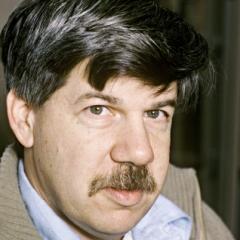
Stephen Jay Gould
Stephen Jay Gould

Stephen Jay Gould was a renowned paleontologist, evolutionary theorist, science writer, and academic. He is known for his work in ornithology, paleontology, evolutionary theory, and speciation. Gould's writings and papers have had a profound impact on the scientific community, and he was a long-time contributor to the journal 'Nature'. more

You May Also Like

“Each worldview was a cultural product, but evolution is true and separate creation is not. [...] Worldviews are social constructions, and they channel the search for facts. But facts are found and knowledge progresses, however fitfully. Fact and theory are intertwined, and all great scientists understand the interaction.”

“Iconography becomes even more revealing when processes or concepts, rather than objects, must be depicted for the constraint of a definite "thing" cedes directly to the imagination. How can we draw "evolution" or "social organization," not to mention the more mundane "digestion" or "self-interest," without portraying more of a mental structure than a physical reality? If we wish to trace the history of ideas, iconography becomes a candid camera trained upon the scholar's mind.”

“Few intellectual tyrannies can be more recalcitrant than the truths that everybody knows and nearly no one can defend with any decent data (for who needs proof of anything so obvious). And few intellectual activities can be more salutary than attempts to find out whether these rocks of ages might crumble at the slightest tap of an informational hammer.”

“When we look to presumed sources of origin for competing evolutionary explanations of the giraffe's long neck, we find either nothing at all, or only the shortest of speculative conjectures. Length, of course, need not correspond with importance. Garrulous old Polonius , in a rare moment of clarity, reminded us that "brevity is the soul of wit" (and then immediately vitiated his wise observation with a flood of woolly words about Hamlet 's Madness.”

“A rare book at once of great importance and wonderful to read.... Gould presents a fascinating historical study of scientific racism, tracing it through monogeny and polygeny, phrenology , recapitulation, and hereditarian IQ theory. He stops at each point to illustrate both the logical inconsistencies of the theories and the prejudicially motivated, albeit unintentional, misuse of data in each case.... A major addition to the scientific literature.”

“Each of the major sciences has contributed an essential ingredient in our long retreat from an initial belief in our own cosmic importance. Astronomy defined our home as a small planet tucked away in one corner of an average galaxy among millions; biology took away our status as paragons created in the image of God; geology gave us the immensity of time and taught us how little of it our own species has occupied.”

“Siphonophores do not convey the message a favorite theme of unthinking romanticism that nature is but one gigantic whole, all its parts intimately connected and interacting in some higher, ineffable harmony. Nature revels in boundaries and distinctions; we inhabit a universe of structure. But since our universe of structure has evolved historically, it must present us with fuzzy boundaries, where one kind of thing grades into another.”

“Antiessentialist thinking forces us to view the world differently. We must accept shadings and continua as fundamental. We lose criteria for judgment by comparison to some ideal: short people, retarded people, people of other beliefs, colors, and religions are people of full status.”