Quotessence
Home / Quotes / Quote by A. E. Housman

Quote by A. E. Housman

“If a man will comprehend the richness and variety of the universe, and inspire his mind with a due measure of wonder and awe, he must contemplate the human intellect not only on its heights of genius but in its abysses of ineptitude.”

Quote by A. E. Housman

Work

Astronomicon

In 'Astronomicon,' the reader is taken on a journey through the cosmos, exploring the characteristics and behaviors of stars, planets, and other celestial objects. The book delves into the history of astronomy, the tools and techniques used by astronomers, and the latest discoveries in the field. more

Author

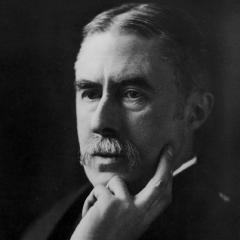
A. E. Housman
A. E. Housman

A. E. Housman, born on March 26, 1859, was a renowned British poet known for his profound emotions and classical style. His works, such as 'A Shropshire Lad', are celebrated for their depth and classical references. Housman's poetry has had a lasting impact on 20th-century British literature and remains widely read and studied today. more

You May Also Like

“If I have put the case of science at all correctly, the reader will have recognised that modern science does much more than demand that it shall be left in undisturbed possession of what the theologian and metaphysician please to term its 'legitimate field'. It claims that the whole range of phenomena, mental as well as physical-the entire universe-is its field. It asserts that the scientific method is the sole gateway to the whole region of knowledge.”

“If that's how it all started, then we might as well face the fact that what's left out there is a great deal of shrapnel and a whole bunch of cinders (one of which is, fortunately, still hot enough and close enough to be good for tanning). Trying to find some sense and order in this mess may be as futile as trying to ... reconstruct the economy of Iowa from a bowl of popcorn. [On searching for evidence of the Big Bang.]”

“If we consider what science already has enabled men to know-the immensity of space, the fantastic philosophy of the stars, the infinite smallness of the composition of atoms, the macrocosm whereby we succeed only in creating outlines and translating a measure into numbers without our minds being able to form any concrete idea of it-we remain astounded by the enormous machinery of the universe.”

“In the vast cosmical changes, the universal life comes and goes in unknown quantities, ... sowing an animalcule here, crumbling a star there, oscillating and ... entangling, from the highest to the lowest, all activities in the obscurity of a dizzying mechanism, hanging the flight of an insect upon the movement of the earth... Enormous gearing, whose first motor is the gnat, and whose last wheel is the zodiac.”

“Knox was engaged in a theological discussion with scientist John Scott Haldane. 'In a universe containing millions of planets,' reasoned Haldane, 'is it not inevitable that life should appear on at least one of them?' 'Sir,' replied Knox, 'if Scotland Yard found a body in your cabin trunk, would you tell them: 'There are millions of trunks in the world; surely one of them must contain a body? I think the would still want to know who put it there'.”