Quotessence
Home / Quotes / Quote by Bryan Stevenson

Quote by Bryan Stevenson

“...even though I’m a product of Brown v. Board of Education, about 12 years ago I realized that I don’t think we could win Brown v. Board of Education today.... I don’t think our court would do anything that disruptive on behalf of disfavored people, on behalf of marginalized people. And that terrified me. But it also energized me to recognize that we were going to have to get outside the court and create a different consciousness. The question for me is, why wouldn’t we win? And it’s because we haven’t really reckoned with these larger issues of what it means to be a country dealing with our history of racial inequality.”

Quote by Bryan Stevenson

Author
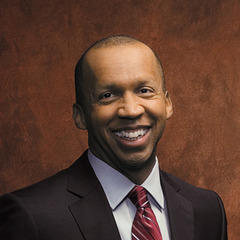
Bryan Stevenson
Bryan Stevenson

Bryan Stevenson is an American lawyer, educator, and social activist known for his contributions to criminal justice reform and the defense of the rights of the poor. Born on November 14, 1959, Stevenson is a professor at the University of Alabama at Birmingham School of Law. more

You May Also Like

“Upper-middle income and high-income nations – countries over the threshold of $10,000 per capita – could in theory deliver flourishing lives for all, achieving real progress in human development, without needing any additional growth in order to do so. We know exactly what works: reduce inequality, invest in universal public goods, and distribute income and opportunity more fairly.”

“Growthism is little more than ideology – an ideology that benefits a few at the expense of our collective future. We’re all pushed to step on the accelerator of growth, with deadly consequences for our living planet, all so that a rich elite can get even richer. From the perspective of human life, this is clearly an injustice. And indeed we have been aware of this problem for some time. But from the perspective of ecology, it is even worse – it is a kind of madness.”

“Once we grasp the scale of national and global inequalities, then the narrative that seeks to cast GDP growth as a proxy for human progress begins to seem a bit tendentious – perhaps even a bit ideological. And by ideology I mean in the technical sense: a set of ideas promoted by the dominant class, which serves their material interests, and which everybody else has internalised to such an extent that they are willing to go along with a system they might otherwise reject as unjust. The Italian philosopher Antonio Gramsci has called this ‘cultural hegemony’: when an ideology becomes so normalised that it is difficult or even impossible to reflect on it.”

“Those who insist that aggregate growth is necessary to improve people’s lives force us into a horrible double-bind. We are made to choose between human welfare or ecological stability – an impossible choice that nobody wants to face. But when we understand how inequality works, suddenly the choice becomes much easier: between living in a more equitable society, on the one hand, and risking ecological catastrophe on the other.”