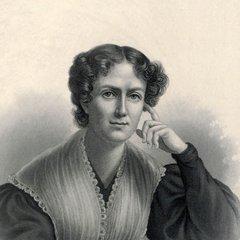
“Knowledge signifies things known. Where there are no things known, there is no knowledge. Where there are no things to be known, there can be no knowledge. We have observed that every science, that is, every branch of knowledge, is compounded of certain facts, of which our sensations furnish the evidence. Where no such evidence is supplied, we are without data; we are without first premises; and when, without these, we attempt to build up a science, we do as those who raise edifices without foundations. And what do such builders construct? Castles in the air.”
Quote by Frances Wright
“... the happiness of a people is the only rational object of government, and the only object for which a people, free to choose, can have a government at all.”
Source: Course of popular lectures; with 3 addresses on various public occasions, and a reply to the charges against the French reformers of 1789
“So long as the mental and moral instruction of man is left solely in the hands of hired servants of the public--let them be teachers of religion, professors of colleges, authors of books, or editors of journals or periodical publications, dependent upon their literary incomes for their daily bread, so long shall we hear but half the truth; and well if we hear so much. Our teachers, political, scientific, moral, or religious; our writers, grave or gay, are compelled to administer to our prejudices and to perpetuate our ignorance.”
“Today three-quarters of the Palestinian people are displaced: there are 5 million Palestinian refugees throughout the world.”
“The best road to correct reasoning is by physical science; the way to trace effects to causes is through physical science; the only corrective, therefore, of superstition is physical science.”
Source: Course of popular lectures
“... a nation to be strong, must be united; to be united, must be equal in condition; to be equal in condition, must be similar inhabits and feeling; to be similar in habits and feeling, must be raised in national institutions as the children of a common family, and citizens of a common country.”
“To give liberty to a slave before he understands its value is, perhaps, rather to impose a penalty than to bestow a blessing.”
Source: Views of society and manners in America: in a series of letters from that country to a friend in England, during the years 1818, 1819, and 1820
“How prone we are to come to the consideration of every question with heads and hearts pre-occupied! How prone to shrink from any opinion, however reasonable, if it be opposed to any, however unreasonable, of our own! How disposed are we to judge, in anger, those who call upon us to think, and encourage us to enquire! To question our prejudices seems nothing less than sacrilege; to break the chains of our ignorance, nothing short of impiety!”
Source: Course of popular lectures
“There is a vulgar persuasion, that the ignorance of women, by favoring their subordination, ensures their utility. 'Tis the same argument employed by the ruling few against the subject many in aristocracies; by the rich against the poor in democracies; by the learned professions against the people in all countries.”
Source: Course of popular lectures as delivered by Frances Wright: with three addresses on various public occasions, and a reply to the charges against the French reformers of 1789. Second edition
“It is in vain that we would circumscribe the power of one half of our race, and that half by far the most important and influential. If they exert it not for good, they will for evil; if they advance not knowledge, they will perpetuate ignorance. Let women stand where they may in the scale of improvement, their position decides that of the race.”
Source: Course of popular lectures; with 3 addresses on various public occasions, and a reply to the charges against the French reformers of 1789
“... it would be impossible for women to stand in higher estimation than they do here. The deference that is paid to them at all times and in all places has often occasioned me as much surprise as pleasure.”
Source: Views of society and manners in America: in a series of letters from that country to a friend in England, during the years 1818, 1819, and 1820