Quotessence
Home / Quotes / Quote by Michel Foucault

Quote by Michel Foucault

Author

Michel Foucault
Michel Foucault

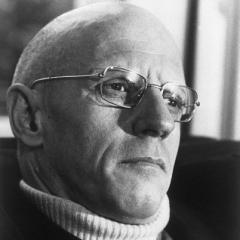
Michel Foucault was a French philosopher known for his critical analysis of knowledge, power, and discourse. His work covered a wide range of topics, including madness, prisons, sexuality, archaeology of knowledge, and biopolitics. Foucault's ideas have had a profound impact on postmodernism, critical theory, and cultural studies. more

You May Also Like

“[T]ruly to escape Hegel involves an exact appreciation of the price we have to pay to detach ourselves from him. It assumes that we are aware of the extent to which Hegel, insidiously perhaps, is close to us; it implies a knowledge, in that which permits us to think against Hegel, of that which remains Hegelian. We have to determine the extent to which our anti-Hegelianism is possibly one of his tricks directed against us, at the end of which he stands, motionless, waiting for us.”

“I'm very proud that some people think that I'm a danger for the intellectual health of students. When people start thinking of health in intellectual activities, I think there is something wrong. In their opinion I am a dangerous man, since I am a crypto-Marxist, an irrationalist, a nihilist.”

“One can say that the author is an ideological product, since we represent him as the opposite of his historically real function. (When a historically given function is represented in a figure that inverts it, one has an ideological production.) The author is therefore the ideological figure by which one marks the manner in which we fear the proliferation of meaning.”

“The constitution of madness as a mental illness, at the end of the eighteenth century, affords the evidence of a broken dialogue, posits the separation as already effected, and thrusts into oblivion all those stammered, imperfect words without fixed syntax in which the exchange between madness and reason was made. The language of psychiatry, which is a monologue of reason about madness, has been established only on the basis of such a silence.”

“In the Renaissance, madness was present everywhere and mingled with every experience by its images or its dangers. During the classical period, madness was shown, but on the other side of bars; if present, it was at a distance, under the eyes of a reason that no longer felt any relation to it and that would not compromise itself by too close a resemblance. Madness had become a thing to look at: no longer a monster inside oneself, but an animal with strange mechanisms, a bestiality from which man had long since been suppressed.”