Quotessence
Home / Quotes / Quote by Gregory of Nazianzus

Quote by Gregory of Nazianzus

“God thought and things came to be, in-formed: the divine thought is the complicated womb of all that is. For it's not likely that, like some painter, He conjured up an image from a similar image, having seen beforehand things which His own one mind did not write.”

Quote by Gregory of Nazianzus

Author
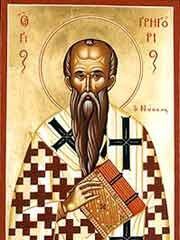
Gregory of Nazianzus

Gregory of Nazianzus (330-390 AD) was an influential Christian saint, theologian, and poet. He is renowned for his contributions to the doctrine of the Trinity within Christian theology. Born in Nazianzus, Asia Minor, he was the brother of Basil of Caesarea, another prominent theologian. His writings and sermons are still widely referenced in the Christian church today. more

You May Also Like

“God is inexhaustible in His gifts to men? Everywhere we see plenty and joy; only the greedy rich lay their hands on and keep in their treasuries too many of God's gifts, which might plentifully nourish hundreds and thousands of poor. Man! Believe firmly in God's inexhaustibility in His gifts, and willingly 'deal your bread to the hungry' (Isa. 58:7)?”

“... if a man prays God for some virtue, and at the same time gives himself up to negligence, acquiring no definite means to gain this virtue, and making no effort towards it, truly this man tempts God, rather than prays. Thus the divine James says: 'The effectual prayer of a righteous man avails much' (Jms. 5:16). What avails to make prayer effective? is when, besides begging a saint to pray for him about something, the man also prays about it himself and with all diligence does everything necessary for obtaining his request.”

“We must, with God's help, eradicate the deadly poison of the demon of anger from the depths of our souls. So long as he dwells in our hearts and blinds the eyes of the heart with his somber disorders, we can neither discriminate what is for our good, nor achieve spiritual knowledge, nor fulfill our good intentions, nor participate in true life; and our intellect will remain impervious to the contemplation of the true, divine light; for it is written, 'Man's anger does not bring about the righteousness of God' (Jms. 1:20).”

“Our Lord reserved to Himself certain things which He would do in due time in a manner outside the course and order of nature, so that they would wonder and be astonished at seeing not great but unusual things, who are unmoved by things daily seen. For the government of the world is a greater miracle than feeding five thousand men from five loaves; yet at the former no one wonders, the latter astonishes all men: not as a greater wonder, but as a rarer.”

“In this we see the wondrous virtue of the Lord: that the power dwelling in His body should communicate to perishable things the efficacy to heal, and that the divine activity should issue forth even from the hem of His garment. For God is not perceptible by the senses, to be enclosed within a body. The assumption of a body did not limit the nature of His power; but for our redemption His power took upon it the frailty of our body.”