Quotessence
Home / Quotes / Quote by Paul Krugman

Quote by Paul Krugman

“To the extent that sacrifices need to be made, shouldn't the people who've made out like bandits this past generation be first in line? The problem with getting out of the slump is that we need to spend more. It's not that somebody needs to spend less. We have idle workers who have the skills and the willingness to work. We have idle factories. Dealing with this is not about saying somebody needs to suffer. It's saying that we need to be prepared to open the taps.”

Quote by Paul Krugman

Author
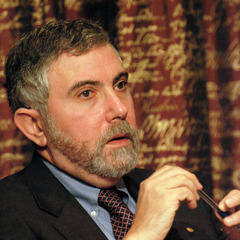
Paul Krugman
Paul Krugman

Paul Krugman is a renowned economist known for his contributions to macroeconomic policy and international trade. He won the Nobel Prize in Economics in 1991 and is considered one of the leading figures in the New Keynesian economics school. more

You May Also Like

“I know that when I look at today’s Mexicans and Central Americans, they seem to me fundamentally the same as my grandparents seeking a better life in America. On the other side, however, open immigration can’t coexist with a strong social safety net; if you’re going to assure health care and a decent income to everyone, you can’t make that offer global. So Democrats have mixed feelings about immigration; in fact, it’s an agonizing issue.”

“If we discovered that, you know, space aliens were planning to attack and we needed a massive buildup to counter the space alien threat and really inflation and budget deficits took secondary place to that, this slump would be over in 18 months. ... There was a Twilight Zone episode like this in which scientists fake an alien threat in order to achieve world peace. Well, this time, we don't need it, we need it in order to get some fiscal stimulus.”

“With the increasingly important role of intelligent machines in all phases of our lives--military, medical, economic and financial, political--it is odd to keep reading articles with titles such as Whatever Happened to Artificial Intelligence? This is a phenomenon that Turing had predicted: that machine intelligence would become so pervasive, so comfortable, and so well integrated into our information-based economy that people would fail even to notice it.”