“If an author be supposed to involve his thoughts in voluntary obscurity, and to obstruct, by unnecessary difficulties, a mind eager in the pursuit of truth; if he writes not to make others learned, but to boast the learning which he possesses himself, and wishes to be admired rather than understood, he counteracts the first end of writing, and justly suffers the utmost severity of censure, or the more afflicting severity of neglect.”
Quote by Samuel Johnson
Work
The Rambler: A Periodical Paper, Published in 1750, 1751, 1752
The Rambler is a series of periodical papers that were published in three separate volumes, spanning the years 1750, 1751, and 1752. Each volume consists of a variety of essays and articles, covering a range of topics including social issues, literature, and philosophy. The work is notable for its contribution to the development of the essay form and its influence on subsequent literary works. more
Author
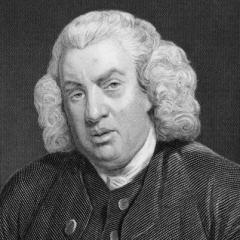
Samuel Johnson
Samuel Johnson was an English writer, poet, and lexicographer, renowned for his comprehensive English dictionary, 'A Dictionary of the English Language', published in 1755. His distinctive writing style and wit have cemented his place as a significant figure in the history of English literature. more
You May Also Like
Source: The Works of Samuel Johnson, L. L. D.: In Twelve Volumes
“While there I began to study the Asian religions as theories of mind.”
Source: The Rambler: A Periodical Paper, Published in 1750, 1751, 1752
Source: The Rambler: A Periodical Paper, Published in 1750, 1751, 1752
Source: The critical opinions of Samuel Johnson
Source: The Works of Samuel Johnson, LL.D.: With An Essay on His Life and Genius
“I told them not to worry about it, since we were going to play indoors.”
“I was a little stunned that we didn't get a coloring book with this menu.”