Quotessence
Home / Quotes / Quote by Stefan Zweig

Quote by Stefan Zweig

“As nature requires whirlwinds and cyclones to release its excessive force in a violent revolt against its own existence, so the spirit requires a demonic human being from time to time whose excessive strength rebels against the community of thought and the monotony of moralityonly by looking at those beyond its limits does humanity come to know its own utmost limits.”

Quote by Stefan Zweig

Author
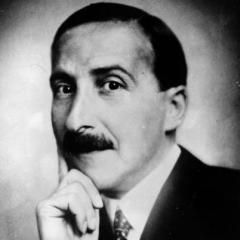
Stefan Zweig
Stefan Zweig

Stefan Zweig, born on November 28, 1881 in Vienna, was an Austrian novelist, playwright, and biographer. Known for his profound psychological insights and unique narrative style, he is a significant figure in European literature at the beginning of the 20th century. more

You May Also Like

“Human life is so strangely constituted that even perfected intellectual understanding combined with the richest experience is incapable of conquering innate weaknesses. Even if it thoroughly analyzes itself, psychology (and this is one of the dubious aspects of psychoanalysis) can, to be sure, recognize its flawed native characteristics, but it cannot eliminate them. Understanding (them) is not the same as overcoming (them) and, again and again, we see the wisest of human beings helpless in the fact of their small follies which everyone else observes with a smile.”

“Fate forces its way to the powerful and violent. With subservient obedience it will assume for years dependency on one individual:Caesar, Alexander, Napoleon, because it loves the elemental human being who grows to resemble it, the intangible element. Sometimes, and these are the most astonishing moments in world history, the thread of fate falls into the hands of a complete nobody but only for a twitching minute.”

“As one who knows many things, the humanist loves the world precisely because of its manifold nature and the opposing forces in itdo not frighten him. Nothing is further from him than the desire to resolve such conflictsand this is precisely the mark of the humanist spirit: not to evaluate contrasts as hostility but to seek human unity, that superior unity, for all that appears irreconcilable.”

“The world has always needed human beings who refuse to believe that history is nothing but a dull, monstrous selfrepetition, a selfperpetuating, meaningless game, only varied in outer garb, who cannot be converted from their conviction that history signifies progress in morality, that our race is ascending on an invisible ladder from an animal nature towards divinity, from brutal violence to the wisely ordering intellect, and that the ultimate stage of complete understanding is already close at hand, indeed has almost been attained.”