Quotessence
Home / Quotes / Quote by Bertrand Russell

Quote by Bertrand Russell

“Every isolated passion, is, in isolation, insane; sanity may be defined as synthesis of insanities. Every dominant passion generates a dominant fear, the fear of its non-fulfillment. Every dominant fear generates a nightmare, sometimes in form of explicit and conscious fanaticism, sometimes in paralyzing timidity, sometimes in an unconscious or subconscious terror which finds expression only in dreams. The man who wishes to preserve sanity in a dangerous world should summon in his own mind a parliament of fears, in which each in turn is voted absurd by all the others.”

Quote by Bertrand Russell

Author
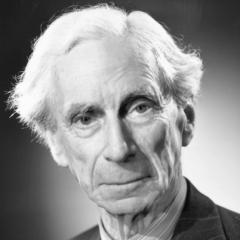
Bertrand Russell
Bertrand Russell

Bertrand Russell was a British philosopher, mathematician, and logician born on May 18, 1872, and died on February 2, 1970. He is known for his contributions to logic and mathematics, particularly in the fields of mathematical logic and philosophical analysis. His works spanned a wide range of subjects, including ethics, political philosophy, history, and literary criticism. more

You May Also Like

“It came to Mr. Blood, as he trudged forward under the laden apple-trees on that fragrant, delicious July morning, that man—as he had long suspected—was the vilest work of God, and that only a fool would set himself up as a healer of a species that was best exterminated.”

“We do not always remember the things that do no credit to us. We justify them, cover them in bright lies or with the thick dust of forgetfulness. All of the things that Shadow had done in his life of which he was not proud, all the things he wished he had done otherwise or left undone, came at him then in a swirling storm of guilt and regret and shame, and he had nowhere to hide from them. He was as naked and as open as a corpse on a table, and dark Anubis the jackal god was his prosector and his prosecutor and his persecutor.”

“Once, in my father's bookshop, I heard a regular customer say that few things leave a deeper mark on a reader than the first book that finds its way into his heart. Those first images, the echo of words we think we have left behind, accompany us throughout our lives and sculpt a palace in our memory to which, sooner or later—no matter how many books we read, how many worlds we discover, or how much we learn or forget—we will return.”

“He domesticated and developed the native wild flowers. He had one hill-side solidly clad with that low-growing purple verbena which mats over the hills of New Mexico. It was like a great violet velvet mantle thrown down in the sun; all the shades that the dyers and weavers of Italy and France strove for through centuries, the violet that is full of rose colour and is yet not lavender; the blue that becomes almost pink and then retreats again into sea-dark purple—the true Episcopal colour and countless variations of it.”