Quotessence
Home / Quotes / Quote by Morihei Ueshiba

Quote by Morihei Ueshiba

“Seeing me before him, / The adversary attacks, / But by that time / I am already standing / Safely behind him.”

Quote by Morihei Ueshiba

Author
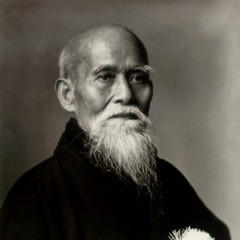
Morihei Ueshiba
Morihei Ueshiba

Morihei Ueshiba, born on December 14, 1883, was a renowned Japanese martial artist and the founder of aikido. His aikido, a martial art that emphasizes harmony and defense, has had a profound impact on the world. Ueshiba's life was marked by his passion for martial arts and his continuous pursuit of improvement. He passed away on April 26, 1969, but his teachings and contributions to the martial arts continue to inspire many to this day. more

You May Also Like

“As far as nonviolence and Spiritual Activism, Marshall Rosenberg is it! Nonviolent Communication: A Language of Life, is essential reading for anyone who wants to improve their communication skills. Applying the concepts within the book will help guide the reader towards a more loving, compassionate, and nonviolent way of understanding and functioning with others, and foster more compassion in the world. I highly recommend this book.”

“If, then, there is some end of the things we do, which we desire for its own sake (everything else being desired for the sake of this), and if we do not choose everything for the sake of something else (for at that rate the process would go on to infinity, so that our desire would be empty and vain), clearly this must be the good and the chief good.”

“Great and frequent reverses can crush and mar our bliss both by the pain they cause and by the hindrance they offer to many activities. Yet nevertheless even in adversity nobility shines through, when a man endures repeated and severe misfortune with patience, not owing to insensibility but from generosity and greatness of soul.”

“There are three things that are the motives of choice and three that are the motives of avoidance; namely, the noble, the expedient, and the pleasant, and their opposites, the base, the harmful, and the painful. Now in respect of all these the good man is likely to go right and the bad to go wrong, but especially in respect of pleasure; for pleasure is common to man with the lower animals, and also it is a concomitant of all the objects of choice, since both the noble and the expedient appear to us pleasant.”

“Error is multiform (for evil is a form of the unlimited, as in the old Pythagorean imagery, and good of the limited), whereas success is possible in one way only (which is why it is easy to fail and difficult to succeed - easy to miss the target and difficult to hit it); so this is another reason why excess and deficiency are a mark of vice, and observance of the mean a mark of virtue: Goodness is simple, badness is manifold.”