Quotessence
Home / Quotes / Quote by Aristotle

Quote by Aristotle

Work

The Nicomachean ethics

Written by Aristotle, The Nicomachean Ethics is a comprehensive treatise on ethics that delves into the nature of virtue, the role of habituation, and the importance of practical wisdom. It is considered one of the most significant texts in the history of philosophy, offering insights into moral character and the pursuit of eudaimonia, or human flourishing. more

Author
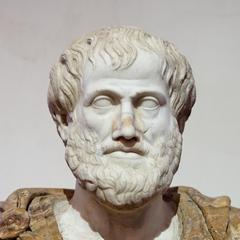
Aristotle
Aristotle

Aristotle, a renowned Greek philosopher, is one of the founders of Western philosophy. His thoughts covered a wide range of fields, including ethics, logic, politics, and had a profound impact on the world. more

You May Also Like

“Error is multiform (for evil is a form of the unlimited, as in the old Pythagorean imagery, and good of the limited), whereas success is possible in one way only (which is why it is easy to fail and difficult to succeed - easy to miss the target and difficult to hit it); so this is another reason why excess and deficiency are a mark of vice, and observance of the mean a mark of virtue: Goodness is simple, badness is manifold.”

“When you have thrown a stone, you cannot afterwards bring it back again, but nevertheless you are responsible for having taken up the stone and flung it, for the origin of the act was within you. Similarly the unjust and profligate might at the outset have avoided becoming so, and therefore they are so voluntarily, although when they have become unjust and profligate it is no longer open to them not to be so.”

“And inasmuch as the great-souled man deserves most, he must be the best of men; for the better a man is the more he deserves, and he that is best deserves most. Therefore the truly great-souled man must be a good man. Indeed greatness in each of the virtues would seem to go with greatness of soul.”

“If a man of good natural disposition acquires Intelligence [as a whole], then he excels in conduct, and the disposition which previously only resembled Virtue, will now be Virtue in the true sense. Hence just as with the faculty of forming opinions [the calculative faculty] there are two qualities, Cleverness and Prudence, so also in the moral part of the soul there are two qualities, natural virtue and true Virtue; and true Virtue cannot exist without Prudence.”

“Therefore the good man ought to be a lover of self, since he will then both benefit himself by acting nobly and aid his fellows; but the bad man ought not to be a lover of self, since he will follow his base passions, and so injure both himself and his neighbors. With the bad man therefore, what he does is not in accord with what he ought to do, but the good man does what he ought, since intelligence always chooses for itself that which is best, and the good man obeys his intelligence.”

“We maintain, and have said in the Ethics, if the arguments there adduced are of any value, that happiness is the realization and perfect exercise of virtue, and this not conditional, but absolute. And I used the term 'conditional' to express that which is indispensable, and 'absolute' to express that which is good in itself.”

“Take the case of just actions; just punishments and chastisements do indeed spring from a good principle, but they are good only because we cannot do without them - it would be better that neither individuals nor states should need anything of the sort - but actions which aim at honor and advantage are absolutely the best. The conditional action is only the choice of a lesser evil; whereas these are the foundation and creation of good. A good man may make the best even of poverty and disease, and the other ills of life.”