Quotessence
Home / Quotes / Quote by Imran Khan

Quote by Imran Khan

“In most of Pakistan it is a feudal country. People are very scared and oppressed by authority. But when you move to these wilder areas, they are not so easily suppressed.”

Quote by Imran Khan

Author
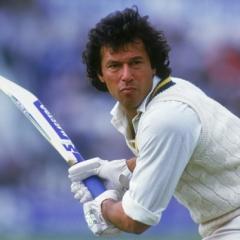
Imran Khan
Imran Khan

Imran Khan is a notable Pakistani politician and former cricket player. He is the founder and leader of the Pakistan Tehreek-e-Insaf (PTI) party, which has gained considerable popularity in Pakistan for its promises of social and economic reforms. Born on November 25, 1952, Khan began his career as a cricket player, achieving international acclaim as the captain of the Pakistani cricket team. After retiring from cricket, he shifted his focus to politics and established the PTI in 1996. Over the years, he has been a vocal advocate for change in Pakistan, addressing issues such as corruption, poverty, and education. Khan's political career has included several key achievements. He served as the Prime Minister of Pakistan from 2018 to 2022, implementing policies aimed at improving the country's economy and social welfare. His tenure was characterized by efforts to combat corruption, promote transparency, and invest in infrastructure. Khan is also recognized for his philanthropic work, particularly through the Shaukat Khanum Memorial Cancer Hospital and Research Centre, which he founded in 1994. Khan's leadership style and policies have been both lauded and criticized. His supporters praise his commitment to social justice and his efforts to reform the political system. Critics, however, argue that his government faced challenges in implementing effective policies and managing the country's economic and security issues. Despite the controversies, Khan remains a significant figure in Pakistani politics, with a strong following and a vision for the country's future. more

You May Also Like

“In the Goldstone Report, Israeli perpetrators of possible crimes against humanity were made subject to prosecution and punishment, although the geopolitical leverage of the United States within the UN prevents implementation. At the same time, several African leaders are being prosecuted for their crimes against humanity and participation in genocide: a double standard of sorts, given the impunity accorded to the West and Israel.”

“There was a deliberate decision after the failure of the League of Nations to make the next attempt to establish a global political actor sensitive to geopolitical realities. The underlying idea was to provide major states, defined in 1945 by reference to the winners in the Second World War (now an anachronism), with assurance that they could take part in the UN without jeopardising their national interests. In this regard, the UN has succeeded, as none of the big countries has withdrawn, and the Organisation has managed to achieve virtually universal membership of all sovereign states.”

“As matters now stand, the veto seems inappropriate, given the absence of any deep ideological split between major states, and definitely constrains the war-prevention mission of the UN. Similarly, the present permanent five are out of touch with geopolitical realities, and constitute a remnant of a West-centric world order, casting a shadow of illegitimacy across the activities of the most important organ of global policymaking in the UN System.”

“To achieve effectiveness and legitimacy it is time to scrap the right of veto given to permanent members of the UN, or at least severely restrict its use. It is also time to either abandon the idea of permanent membership or broaden it to reflect the rise of non-Western states to the status of global leaders (e.g. Brazil, India, Indonesia, Turkey, South Africa), and to downgrade European representation by either giving the European Union a single seat or rotating a European state among Germany, France, UK, and Italy.”

“The Goldstone Report establishes the credibility of the accusations directed at Israel with respect to its tactics used during the 2008 - 09 attacks on Gaza, but was not able to facilitate the next step that would have involved activating accountability mechanisms either within Israel or at the level of international society.”

“There are degrees of incompatibility, and there are more factors relevant to upholding democracy and human rights than the operation of neoliberal markets. Perhaps this point can be initially made by reference to the decline of democracy and the erosion of human rights within the United States since the 9/11 attacks.”

“Cumulatively, American society is sliding toward a new form of 'authoritarian democracy'. Elections continue, free speech is generally protected, institutions operate in accordance with the Constitution, but the reality of state - society relations is dramatically altered by the counter-terrorist claims of emergency rule and the right of exception.”