Quotessence
Home / Quotes / Quote by Michel Foucault

Quote by Michel Foucault

“Relations of power "are indissociable from a discourse of truth, and they can neither be established nor function unless a true discourse is produced, accumulated, put into circulation, and set to work. Power cannot be exercised unless a certain economy of discourses of truth functions in, on the basis of, and thanks to, that power."”

Quote by Michel Foucault

Author
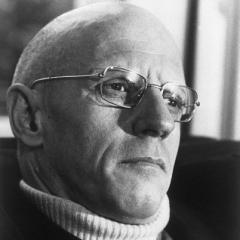
Michel Foucault
Michel Foucault

Michel Foucault was a French philosopher known for his critical analysis of knowledge, power, and discourse. His work covered a wide range of topics, including madness, prisons, sexuality, archaeology of knowledge, and biopolitics. Foucault's ideas have had a profound impact on postmodernism, critical theory, and cultural studies. more

You May Also Like

“... we are obliged to produce the truth by the power that demands truth and needs it in order to function: we are constrained, we are condemned to admit the truth or to discover it. Power constantly asks questions and questions us; it constantly investigates and records; it institutionalizes the search for the truth, professionalizes it, and rewards it. ... In a different sense, we are also subject to the truth in the sense that truth lays down the law: it is the discourse of truth that decides, at least in part; it conveys and propels effects of power.”

“We should not be content to say that power has a need for such-and-such a discovery, such-and-such a form of knowledge, but we should add that the exercise of power itself creates and causes to emerge new objects of knowledge and accumulates new bodies of information. ... The exercise of power perpetually creates knowledge and, conversely, knowledge constantly induces effects of power. ... It is not possible for power to be exercised without knowledge, it is impossible for knowledge not to engender power.”

“At the heart of capitalism is the unification of knowledge and power. As Friedrich Hayek, the leader of the Austrian school of economics, put it, "To assume all the knowledge to be given to a single mind... is to disregard everything that is important and significant in the real world." Because knowledge is dispersed, power must be as well.”

“Enforced by genetics, sexual reproduction, perspective, and experience, the most manifest characteristic of human beings is their diversity. The freer an economy is, the more this human diversity of knowledge will be manifested. By contrast, political power originates in top-down processes-governments, monopolies, regulators, and elite institutions- all attempting to quell human diversity and impose order. Thus power always seeks centralization.”

“In an information economy, entrepreneurs master the science of information in order to overcome the laws of the purely physical sciences. They can succeed because of the surprising power of the laws of information, which are conducive to human creativity. The central concept of information theory is a measure of freedom of choice. The principle of matter, on the other hand, is not liberty but limitation- it has weight and occupies space.”

“From the equilibrium and spontaneous order of Adam Smith and his heirs, from invisible-handed markets and perfect competition, supply and demand, and rewards and punishments, I was pushed to theories of disequilibrium and disorder, and information and noise, as the keys to understanding economic progress.”

“The most important feature of an information economy, in which information is defined as surprise, is the overthrow, not the attainment, of equilibrium. The science that we have come to know as information theory establishes the supremacy of the entrepreneur because it appreciates the powerful connection between destruction and what Schumpeter described as "creative destruction," between chaos and creativity.”

“In order to understand the movement of prices, you need not an oscilloscope to measure the entire market and reduce it to noise, but a microscope to investigate the creative process behind every company and its price.”

“It's really hard to design products by focus groups. A lot of times, people don't know what they want until you show it to them. As Henry Ford said many years earlier: "If I had listened to my customers, I would have built a faster horse." Inventions in general express Shannon entropy. They come from the supply side.”