Quotessence
Home / Quotes / Quote by Marcus Tullius Cicero

Quote by Marcus Tullius Cicero

“When confronted by a hungry wolf, it is unwise to goad the beast, as Cato would have us do. But it is equally unwise to imagine the snarling animal a friend and offer your hand, as Pompey does." "Perhaps you would have us climb a tree!”

Quote by Marcus Tullius Cicero

Author
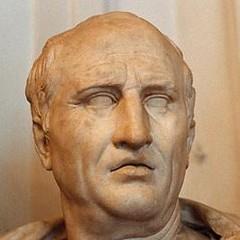
Marcus Tullius Cicero

Marcus Tullius Cicero was a prominent philosopher, politician, lawyer, orator, and writer during the late Roman Republic. The exact dates of his birth and death are unknown, but he was active in the 1st century BC. Known for his profound thoughts and exceptional literary style, Cicero has had a lasting impact on Western culture. more

You May Also Like

“In a general view, there are few conquests that repay the charge of making them, and mankind are pretty well convinced that it can never be worth their while to go to war for profit's sake. If they are made war upon, their country invaded, or their existence at stake, it is their duty to defend and preserve themselves, but in every other light, and from every other cause, is war inglorious and detestable.”

“"Peace" is a condition in which no civilian pays any attention to military casualties which do not achieve page-one, lead-story prominence-unless that civilian is a close relative of one of the casualties. But, if there ever was a time in history when "peace" meant that there was no fighting going on, I have been unable to find out about it.”

“No war ought ever to be undertaken but under circumstances which render all intercourse of courtesy between the combatants impossible. It is a bad thing that men should hate each other; but it is far worse that they should contract the habit of cutting one another's throats without hatred. War is never lenient but where it is wanton; when men are compelled to fight in self-defence, they must hate and avenge: this may be bad; but it is human nature.”

“To carry the spirit of peace into war is a weak and cruel policy. When an extreme case calls for that remedy which is in its own nature most violent, and which, in such cases, is a remedy only because it is violent, it is idle to think of mitigating and diluting. Languid war can do nothing which negotiation or submission will do better: and to act on any other principle is, not to save blood and money, but to squander them.”

“The dogmas of the quiet past are inadequate to the stormy present. The occasion is piled high with difficulty, and we must rise to the occasion. We cannot escape history. We will be remembered in spite of ourselves. The fiery trial through which we pass will light us down in honour or dishonour, to the last generation. We shall nobly save, or meanly lose, our last best hope of Earth.”