Quotessence
Home / Quotes / Quote by Werner Heisenberg

Quote by Werner Heisenberg

Work

Gesammelte Werke

This collection encompasses a wide array of the author's writings, including poetry, prose, and critical essays, showcasing their diverse range of styles and themes. more
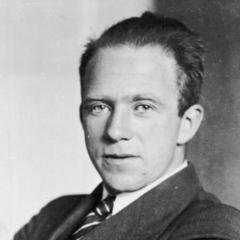
Author

Werner Heisenberg
Werner Heisenberg

German theoretical physicist and one of the founders of quantum mechanics, known for his formulation of the uncertainty principle. He made significant contributions to the field of physics, particularly in quantum mechanics and nuclear physics. more

You May Also Like

“If any human being earnestly desire to push on to new discoveries instead of just retaining and using the old; to win victories over Nature as a worker rather than over hostile critics as a disputant; to attain, in fact, clear and demonstrative knowlegde instead of attractive and probable theory; we invite him as a true son of Science to join our ranks.”

“If Watson and I had not discovered the [DNA] structure, instead of being revealed with a flourish it would have trickled out and that its impact would have been far less. For this sort of reason Stent had argued that a scientific discovery is more akin to a work of art than is generally admitted. Style, he argues, is as important as content. I am not completely convinced by this argument, at least in this case.”

“In that memorable year, 1822: Oersted, a Danish physicist, held in his hands a piece of copper wire, joined by its extremities to the two poles of a Volta pile. On his table was a magnetized needle on its pivot, and he suddenly saw (by chance you will say, but chance only favours the mind which is prepared) the needle move and take up a position quite different from the one assigned to it by terrestrial magnetism. A wire carrying an electric current deviates a magnetized needle from its position. That, gentlemen, was the birth of the modern telegraph.”

“In the history of physics, there have been three great revolutions in thought that first seemed absurd yet proved to be true. The first proposed that the earth, instead of being stationary, was moving around at a great and variable speed in a universe that is much bigger than it appears to our immediate perception. That proposal, I believe, was first made by Aristarchos two millenia ago ... Remarkably enough, the name Aristarchos in Greek means best beginning.”

“In the world's history certain inventions and discoveries occurred, of peculiar value, on account of their great efficiency in facilitating all other inventions and discoveries. Of these were the art of writing and of printing - the discovery of America, and the introduction of Patent-laws. The date of the first ... is unknown; but it certainly was as much as fifteen hundred years before the Christian era; the second-printing-came in 1436, or nearly three thousand years after the first. The others followed more rapidly - the discovery of America in 1492, and the first patent laws in 1624.”

“Indeed, nothing more beautifully simplifying has ever happened in the history of science than the whole series of discoveries culminating about 1914 which finally brought practically universal acceptance to the theory that the material world contains but two fundamental entities, namely, positive and negative electrons, exactly alike in charge, but differing widely in mass, the positive electron-now usually called a proton-being 1850 times heavier than the negative, now usually called simply the electron.”

“It can happen to but few philosophers, and but at distant intervals, to snatch a science, like Dalton, from the chaos of indefinite combination, and binding it in the chains of number, to exalt it to rank amongst the exact. Triumphs like these are necessarily 'few and far between.'”