Quotessence
Home / Quotes / Quote by Gilbert K. Chesterton

Quote by Gilbert K. Chesterton

“It was the mystical dogma of Bentham and Adam Smith and the rest, that some of the worst of human passions would turn out to be all for the best. It was the mysterious doctrine that selfishness would do the work of unselfishness.”

Quote by Gilbert K. Chesterton

Author
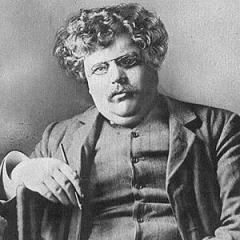
Gilbert K. Chesterton

Gilbert K. Chesterton was an English writer, critic, and theologian, born on May 29, 1874, and died on June 14, 1936. Known for his unique literary style and profound philosophical thinking, Chesterton's works spanned a variety of genres, including novels, poetry, drama, and criticism. more

You May Also Like

“Journalism only tells us what men are doing; it is fiction that tells us what they are thinking, and still more what they are feeling. If a new scientific theory finds the soul of a man in his dreams, at least it ought not to leave out his day-dreams. And all fiction is only a diary of day-dreams instead of days. And this profound preoccupation of men's minds with certain things always eventually has an effect even on the external expression of the age.”

“The life of a thinking man will probably be divided into two parts -- the first in which he desires to exterminate modern thinkers, and the second in which he desires to watch them exterminating each other. ... Suppose, for instance, there is an old story and a new skeptic who is skeptical of the story. We have only to wait a little while for a yet newer skeptic who is skeptical of the skeptic. He will probably find the old notion actually a help in his new notion. This process is an abstract truth applying to anything, apart from agreement or disagreement.”

“The last few decades have been marked by a special cultivation of the romance of the future. We seem to have made up our minds to misunderstand what has happened; and we turn, with a sort of relief, to stating what will happen-which is apparently much easier...The modern mind is forced towards the future by a certain sense of fatigue, not unmixed with terror, with which it regards the past.”

“The Byzantines hammered away at their hard and orthodox symbols, because they could not be in a mood to believe that men could take a hint. The moderns drag out into lengths and reels of extravagance their new orthodoxy of being unorthodox, because they also cannot give a hint -- or take a hint. Yet all perfect and well-poised art is really a hint.”