Quotessence
Home / Quotes / Quote by Hermann Hesse

Quote by Hermann Hesse

“When someone is seeking,” said Siddartha, “It happens quite easily that he only sees the thing that he is seeking; that he is unable to find anything, unable to absorb anything, because he is only thinking of the thing he is seeking, because he has a goal, because he is obsessed with his goal. Seeking means: to have a goal; but finding means: to be free, to be receptive, to have no goal. You, O worthy one, are perhaps indeed a seeker, for in striving towards your goal, you do not see many things that are under your nose.”

Quote by Hermann Hesse

Work

Siddhartha

Hermann Hesse's 'Siddhartha' is a profound exploration of the human quest for enlightenment and self-discovery. The story follows the life of Siddhartha, a young Brahmin who leaves his family and societal expectations to seek truth and wisdom. His journey takes him through various experiences, including asceticism, wealth, and love, as he grapples with the complexities of life and the nature of reality. more

Author

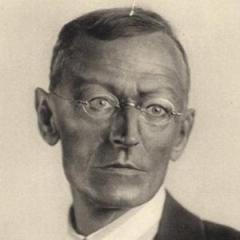
Hermann Hesse
Hermann Hesse

Hermann Hesse was a German poet and novelist, born on July 2, 1877, and died on August 9, 1962. Known for his profound psychological descriptions and exploration of human nature, his works include classics such as 'Steppenwolf' and 'The Glass Bead Game'. more

You May Also Like

“Thousands of years before Christianity, secret cults arose which worshipped the sacred mushroom—the Amanita Muscaria—which, for various reasons (including its shape and power as a drug) came to be regarded as a symbol of God on earth. When the secrets of the cult had to be written down, it was done in the form of codes hidden in folk tales. This is the basic origin of the stories in the New Testament. They are a literary device to spread the rites and rules of mushroom worship to the faithful.”

“Moreover, it is not just that the early documents are silent about so much of Jesus that came to be recorded in the gospels, but that they view him in a substantially different way -- as a basically supernatural personage only obscurely on Earth as a man at some unspecified period in the past, 'emptied' then of all his supernatural attributes (Phil.2:7), and certainly not a worker of prodigious miracles which made him famous throughout 'all Syria' (Mt.4:24). I have argued that there is good reason to believe that the Jesus of Paul was constructed largely from musing and reflecting on a supernatural 'Wisdom' figure, amply documented in the earlier Jewish literature, who sought an abode on Earth, but was there rejected, rather than from information concerning a recently deceased historical individual. The influence of the Wisdom literature is undeniable; only assessment of what it amounted to still divides opinion.”

“If there is one fable, which would seem entitled to escape the analysis, which we have undertaken of religious poems and sacred legends, by the laws of physical and astronomical science, it is doubtless that of Christ, or the legend, which under that name is really dedicated to the worship of the Sun. The hatred, which the sectarians of that religion,—jealous to make their form of worship dominant over all others,—have shown against those, who worshipped Nature, the Sun, the Moon and the Stars, against the Roman Deities, whose temples and altars they have upset,—would suscitate the idea, that their worship did not form a part of that otherwise universal religion.”

“I argue that the Jesus of the Gospels is essentially a myth. The Gospels are largely fiction. They were created around the turn of the first and second century in order to give concreteness and substance to the Jesus who, as the Messiah, had appeared to Paul and his fellow apostles in ecstatic visions.”

“Philosophically, I am a logical empiricist and materialist, and I am a veteran of over 400 radio and TV interviews and debates. I am a Christ-myth advocate and am pursuing research into how Christianity could have begun without a historical Jesus of Nazareth. I am married with one daughter and three grandchildren.”

“Young scholars, learning their historical method from Gospel scholars, often treat it as self-evident that the more skeptical they are toward their sources, the more rigorous will be their historical method. It has to be said, over and over, that historical rigor does not consist in fundamental skepticism toward historical testimony but in fundamental trust along with testing by critical questioning…”

“...if we apply to the New Testament, as we should, the same sort of criteria as we should apply to other ancient writings containing historical material, we can no more reject Jesus' existence than we can reject the existence of a mass of pagan personages whose reality as historical figures is never questioned.”