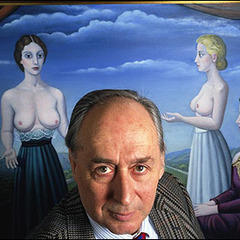
“I felt the pressure of imagination against the doors of my mind was so great that they were going to burst.” Quote by J. G. Ballard
“But I wouldn't recommend writing. You can be a successful writer and never meet another soul. I'm not sure that's a good thing.” WritingSoulSuccessfulGood ThingsNot Sure Author:J. G. Ballard
“I work for three or four hours a day, in the late morning and early afternoon. Then I go out for a walk and come back in time for a large gin and tonic.” ThreeHoursWalksMorningFourLateAfternoonGinBack In TimeGin And Tonic Author:J. G. Ballard
“I've never suffered from writer's block. I have plenty of ideas, sometimes too many. I've always had a strong imagination. If it dries up I'll stop and look for another career.” IfsLooksIdeasSometimesStrongImaginationCareersBlockPlentyWriter's Block Author:J. G. Ballard
“Take the gesture, the action of writing. I have an almost obsessive relation to writing instruments. I often switch from one pen to another just for the pleasure of it. I try out new ones. I have far too many pens - I don't know what to do with all of them! And yet, as soon as I see a new one, I start craving it. I cannot keep myself from buying them.” KnowsWritingTryingActionPleasureRelationInstrumentsBuyingPensGesturesCravingObsessive Author:Roland Barthes
“Most people write the same sentence over and over again. The same number of words-say, 8-10, or 10-12. The same sentence structure. Try to become stretchy-if you generally write 8 words, throw a 20 word sentence in there, and a few three-word shorties. If you're generally a 20 word writer, make sure you throw in some threes, fivers and sevens, just to keep the reader from going crosseyed.” PeopleIfsWritingTryingThreeNumbersReaderStructureSentencesThree WordsSentence Structure Author:Janet Fitch
“A dependent clause (a sentence fragment set off by commas, dontcha know) helps you explore your story by moving you deeper into the sentence. It allows you to stop and think harder about what you've already written. Often the story you're looking for is inside the sentence. The dependent clause helps you uncover it.” ThinkingKnowsHelpingStoriesMovingWrittenHarderDeeperSentencesDependentFragmentsClauses Author:Janet Fitch
“Always tell us where we are. And don't just tell us where something is, make it pay off. Use description of landscape to help you establish the emotional tone of the scene. Keep notes of how other authors establish mood and foreshadow events by describing the world around the character. Look at the openings of Fitzgerald stories, and Graham Greene, they're great at this.” WorldLooksCharacterHelpingStoriesUsePayEventsEmotionalSceneNotesMoodOpeningLandscapeToneDescriptionDescribing Author:Janet Fitch
“This involves more than I can discuss here, but do it. Read the writers of great prose dialogue-people like Robert Stone and Joan Didion. Compression, saying as little as possible, making everything carry much more than is actually said. Conflict. Dialogue as part of an ongoing world, not just voices in a dark room. Never say the obvious. Skip the meet and greet.” PeopleWorldLittlesSaidI CanVoiceDarkRoomsConflictStonesObviousDialogueProseOngoingSkipDark RoomCompression Author:Janet Fitch
“What is a scene? a) A scene starts and ends in one place at one time (the Aristotelian unities of time and place-this stuff goes waaaayyyy back). b) A scene starts in one place emotionally and ends in another place emotionally. Starts angry, ends embarrassed. Starts lovestruck, ends disgusted. c) Something happens in a scene, whereby the character cannot go back to the way things were before. Make sure to finish a scene before you go on to the next. Make something happen.” WayEndsCharacterHappensNextStuffGoes OnSceneAngryUnityThings HappenOne TimeEmbarrassedDisgusted Author:Janet Fitch
“I don't think it's any fun, even if you are one of the most respected authors in the world like Margaret Atwood, to keep being nominated and not win.” IfsThinkingWorldWinningFun Author:Kazuo Ishiguro