Quotessence
Home / Quotes / Quote by Bernard Law Montgomery

Quote by Bernard Law Montgomery

“On the eve of this great adventure I send my best wishes to every soldier in the Allied team. To us is given the honour of striking a blow for freedom which will live in history; and in the better days that lie ahead men will speak with pride of our doings.”

Quote by Bernard Law Montgomery

Author
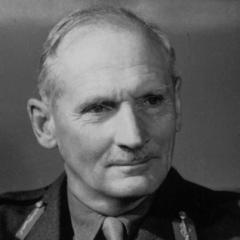
Bernard Law Montgomery

General Bernard Law Montgomery, born on November 17, 1887, and died on March 24, 1976, was a British military leader renowned for his exceptional command during World War II. He is best known for his leadership in the North African, Italian, and Western European campaigns. Montgomery's strategic insights and tactics had a significant impact on modern warfare theory. more

You May Also Like

“In the index to the six hundred odd pages of Arnold Toynbee's A Study of History, abridged version, the names of Copernicus, Galileo, Descartes and Newton do not occur yet their cosmic quest destroyed the medieval vision of an immutable social order in a walled-in universe and transformed the European landscape, society, culture, habits and general outlook, as thoroughly as if a new species had arisen on this planet.”

“In the course of history, all empires have been created with premeditation, by an effort often sustained over several generations. Every power has been Roman to a degree. The United States is the first nation to become the most powerful in the world without having sought to be so. Its exceptional energy and organization have never been oriented toward conquest.”

“ZOOLOGY, n. The science and history of the animal kingdom, including its king, the House Fly ("Musca maledicta"). The father of Zoology was Aristotle, as is universally conceded, but the name of its mother has not come down to us.”

“I will not go so far as to say that to construct a history of thought without profound study of the mathematical ideas of successive epochs is like omitting Hamlet from the play which is named after him. That would be claiming too much. But it is certainly analogous to cutting out the part of Ophelia. This simile is singularly exact. For Ophelia is quite essential to the play, she is very charming . . . and a little mad.”