“Whatever advantage we snatch beyond a certain portion allotted us by at nature, is like money spent before it is due, which, at the time of regular payment, will be missed and regretted.”
Quote by Samuel Johnson
Work
The Works of Alexander Pope, Esq. in Verse and Prose: Containing the Principal Notes of Drs. Warburton and Warton: Illustrations, and Critical and Explanatory Remarks, by Johnson, Wakefield, A. Chalmers ... and Others; to which are Added, Now First Published, Some Original Letters, with Additional Observations, and Memoirs of the Life of the Author
This book is a compilation of Alexander Pope's literary works, spanning both verse and prose. It includes critical annotations by Drs. Warburton and Warton, as well as additional observations and commentary. The volume also features a selection of Pope's original letters, published for the first time, along with biographical notes and a memoir of the author's life. more
Author
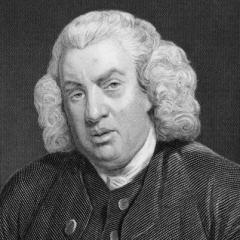
Samuel Johnson
Samuel Johnson was an English writer, poet, and lexicographer, renowned for his comprehensive English dictionary, 'A Dictionary of the English Language', published in 1755. His distinctive writing style and wit have cemented his place as a significant figure in the history of English literature. more
You May Also Like
“Beauty, without kindness, dies unenjoyed and undelighting.”
Source: The Beauties of Samuel Johnson, LL.D.: Consisting of Maxims and Observations, Moral, Critical, and Miscellaneous : to which are Now Added, Biographical Anecdotes of the Doctor, Selected from the Works of Mrs. Piozzi, His Life, Recently Published by Mr. Boswell, and Other Authentic Testimonies : Also His Will, and the Sermon He Wrote for the Late Doctor Dodd
“There is no book so poor that it would not be a prodigy if wholly made by a single man.”
“Care that is once enter'd into the breast Will have the whole possession ere it rest.”
Source: The Rambler: A Periodical Paper, Published in 1750, 1751, 1752
Source: Boswell's Life of Johnson: Including Boswell's Journal of a Tour of the Hebrides, and Johnson's Diary of A Journey Into North Wales
“The peculiar doctrine of Christianity is that of a universal sacrifice and perpetual propitiation.”
Source: The Life of Samuel Johnson
Source: The Beauties of Johnson: Consisting of Maxims and Observations, Moral, Critical, and Miscellaneous, Accurately Extracted from the Works of Dr. Samuel Johnson, and Arranged in Alphabetical Order, After the Manner of the Duke de la Roche-Foucault's Maxims
“Sir, there is no end of negative criticism.”
Source: Journey to the Hebrides: A Journey to the Western Islands of Scotland & The Journal of a Tour to the Hebrides
“Critics, like the rest of mankind, are very frequently misled by interest.”
Source: The Works of Samuel Johnson, LL.D.: With An Essay on His Life and Genius