Quotessence
Home / Quotes / Quote by Fannie Lou Hamer

Quote by Fannie Lou Hamer

“I remember, and I will never forget, one day - I was six years old and I was playing beside the road and this plantation owner drove up to me and stopped and asked me "could I pick some cotton." I told him I didn't know and he said, "Yes, you can. I will give you things that you want from the commissary store," and he named a huge list that he called off. I picked the 30 pounds of cotton that week, but I found out what actually happened was he was trapping me into beginning the work I was to keep doing and I never did get out of his debt again.”

Quote by Fannie Lou Hamer

Author
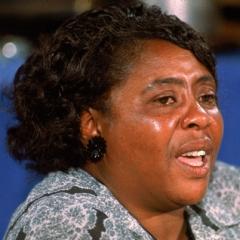
Fannie Lou Hamer
Fannie Lou Hamer

Fannie Lou Hamer was a prominent political leader and civil rights activist from the United States. Born on October 6, 1917, in Montgomery County, Mississippi, she dedicated her life to fighting for racial equality and women's rights. Hamer's experiences as a sharecropper and her involvement in the civil rights movement, particularly her leadership in the Mississippi Freedom Democratic Party, made her a symbol of resistance and empowerment. She passed away on March 14, 1977. more

You May Also Like

“[My father] did get enough money to buy mules. We didn't have tractors, but he bought mules, wagons, cultivators and some farming equipment. As soon as he bought that and decided to rent some land, because it was always better if you rent the land, but as soon as he got the mules and wagons and everything, somebody went to our trough - a white man who didn't live very far from us - and he fed the mules Paris Green, put it in their food and it killed the mules and our cows.”

“We worked all the time, just worked and then we would be hungry and my mother was clearing up a new ground trying to help feed us for $1.25 a day. She was using an axe, just like a man, and something flew up and hit her in her eye. It eventually caused her to lose both of her eyes and I began to get sicker and sicker of the system there. I used to see my mother wear clothes that would have so many patches on them, they had been done over and over and over again. She would do that but she would try to keep us decent.”

“[My mother] tried so hard to make life easy for us. Those are the things that forced me to try to do something different and when this Movement came to Mississippi I still feel it is one of the greatest things that ever happened because only a person living in the State of Mississippi knows what it is like to suffer; knows what it is like to be hungry; knows what it is like to have no clothing to wear.”