Quotessence
Home / Quotes / Quote by Sophocles

Quote by Sophocles

“Oh death, death, why do you never come to me thus summoned always day by day?”

Quote by Sophocles

Author
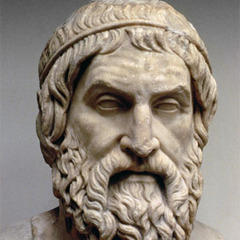
Sophocles
Sophocles

Sophocles, born in 498 BC and died in 406 BC, was a renowned Greek tragic playwright. He is one of the three greatest tragic poets of ancient Greece, alongside Aeschylus and Euripides. Sophocles' works profoundly revealed the complexity of human nature and social contradictions, exerting a profound influence on subsequent drama. more

You May Also Like

“A tattered copy of Johnson's large Dictionary was a great delight to me, on account of the specimens of English versifications which I found in the Introduction. I learned them as if they were so many poems. I used to keep this old volume close to my pillow; and I amused myself when I awoke in the morning by reciting its jingling contrasts of iambic and trochaic and dactylic metre, and thinking what a charming occupation it must be to "make up" verses.”

“It is a conquest when we can lift ourselves above the annoyances of circumstances over which we have no control; but it is a greater victory when we can make those circumstances our helpers,--when we can appreciate the good there is in them. It has often seemed to me as if Life stood beside me, looking me in the face, and saying, "Child, you must learn to like me in the form in which you see me, before I can offer myself to you in any other aspect.”

“The New Hampshire girls who came to Lowell were descendants of the sturdy backwoodsmen who settled that State scarcely a hundred years before.... They were earnest and capable; ready to undertake anything that was worth doing. My dreamy, indolent nature was shamed into activity among them. They gave me a larger, firmer ideal of womanhood.”

“In the older times it was seldom said to little girls, as it always has been said to boys, that they ought to have some definite plan, while they were children, what to be and do when they were grown up. There was usually but one path open before them, to become good wives and housekeepers. And the ambition of most girls was to follow their mothers' footsteps in this direction; a natural and laudable ambition. But girls, as well as boys, must often have been conscious of their own peculiar capabilities,--must have desired to cultivate and make use of their individual powers.”

“Tailor's work--the finishing of men's outside garments--was the "trade" learned most frequently by women in [the 1820s and 1830s],and one or more of my older sisters worked at it; I think it must have been at home, for I somehow or somewhere got the idea, while I was a small child, that the chief end of woman was to make clothing for mankind.”