Quotessence
Home / Quotes / Quote by Nhat Hanh

Quote by Nhat Hanh

“We are determined not to take as the aim of our life fame, profit, wealth, or sensual pleasure, nor to accumulate wealth while millions are hungry and dying. We are committed to living simply and sharing our time, energy, and material resources with those who are in need.”

Quote by Nhat Hanh

Work

Being Peace

Being Peace is a classic work by Thich Nhat Hanh that introduces the principles of mindfulness and meditation as practical tools for achieving personal and global peace. The book emphasizes the importance of being present in each moment, transforming suffering through awareness, and fostering loving-kindness. It offers simple exercises and reflections to integrate peace into everyday activities, encouraging readers to become agents of harmony in their own lives and communities. more

Author

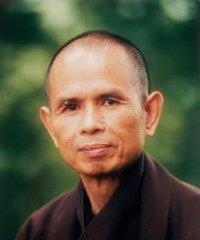
Nhat Hanh
Nhat Hanh

Thich Nhat Hanh is a Vietnamese-French monk, writer, and peace activist. Born on October 11, 1926, he is a prominent figure in the Zen Buddhist tradition, known for his simple yet profound teachings and advocacy for peace. more

You May Also Like

“We did not choose to believe that personal choice is the highest human virtue. Rather, we were taught, formed, forced to believe nothing is important in life other than that which we have personally chosen. The irony is that the belief that nothing is important in life other than that which we have personally chosen is a belief that we have not personally chosen! The supermarket and shopping mall have been our school.”

“We had learned how to invent things, and the question of why we invent things receded in importance. The idea that if something could be done it should be done was born in the nineteenth century. And along with it, there developed a profound belief in all the principles through which invention succeeds: objectivity, efficiency, expertise, standardization, measurement, and progress. It also came to be believed that the engine of technological progress worked most efficiently when people are conceived of not as children of God or even as citizens but as consumers-that is to say, as markets.”

“We have created new idols. The worship of the ancient golden calf (cf. Ex 32:1-35) has returned in a new and ruthless guise in the idolatry of money and the dictatorship of an impersonal economy lacking a truly human purpose. The worldwide crisis affecting finance and the economy lays bare their imbalances and, above all, their lack of real concern for human beings; man is reduced to one of his needs alone: consumption.”

“We must surely appear to the world as exactly what we are: a nation that organizes its economy around consuming twice as much oil as it produces, and around the profligate wastefulness of the wars and campaigns required to defend such consumption. In recent years we have defined our national interest largely in terms of the oil fields and pipelines we need to procure fuel.”

“We, all of us in the First World, have participated in something of a binge, a half century of unbelievable prosperity and ease. We may have had some intuition that it was a binge and the earth couldn't support it, but aside from the easy things (biodegradable detergent, slightly smaller cars) we didn't do much. We didn't turn our lives around to prevent it. Our sadness is almost an aesthetic response - appropriate because we have marred a great, mad, profligate work of art, taken a hammer to the most perfectly proportioned of sculptures.”

“You cannot dream yourself into a character; you must hammer and forge yourself one.”

“What will you do if your product still further increases next year? You should then destroy again the warehouses which you are now preparing to build, and build bigger. For the reason why God has given you fruitful harvests is that He might either overcome your avarice or condemn it; wherefore you can have no excuse. But you keep for yourself what He wished to be produced through you for the benefit of many - nay, rather, you rob even yourself of it, since you would better preserve it for yourself if you distributed it to others.”