Quotessence
Home / Quotes / Quote by Karl Barth

Quote by Karl Barth

Work

Church Dogmatics: pt. 1. The doctrine of the word of God

This book is the first part of a multi-volume theological treatise that delves into the theological significance and interpretation of the word of God in Christian belief and practice. more

Author
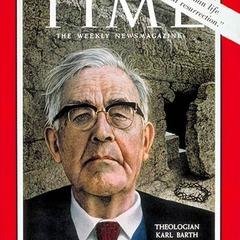
Karl Barth
Karl Barth

Karl Barth was a Swiss theologian born on May 10, 1886, and died on December 10, 1968. He is considered one of the most influential theologians of the 20th century, known for his critical theological method and profound biblical exegesis. more

You May Also Like

“There is a notion that complete impartiality is the most fitting and indeed the normal disposition for true exegesis , because it guarantees complete absence of prejudice. For a short time, around 1910, this idea threatened to achieve almost a canonical status in Protestant theology. But now, we can quite calmly describe it as merely comical.”

“We are now assuming that we have here the centre and goal of all God's works, and therefore the hidden beginning of them all. We are also assuming that the prominent place occupied by this divine work has something corresponding to it in the essence of God, that the Son forms the centre of the Trinity, and that the essence of the divine being has, so to speak, its locus ... in His work, in the name and person of Jesus Christ.”

“The enterprise of Adolf Hitler, with all its clatter and fireworks, and all its cunning and dynamic energy, is the enterprise of an evil spirit, which is apparently allowed its freedom for a time in order to test our faith in the Resurrection of Jesus Christ.”

“Although a person acting under authority performs actions that seem to violate standards of conscience, it would not be true to say that he loses his moral sense. Instead, it acquires a radically different focus. He does not respond with a moral sentiment to the actions he performs. Rather, his moral concern now shifts to a consideration of how well he is living up to the expectations that the authority has of him.”

“I would say, on the basis of having observe a thousand people in the experiment and having my own intuition shaped and informed by these experiments, that if a system of death camps were set up in the United States of the sort we had seen in Nazi Germany, one would find sufficient personnel for those camps in any medium-sized American town.”