Quotessence
Home / Quotes / Quote by Dwight D. Eisenhower

Quote by Dwight D. Eisenhower

Work

Public Papers of the Presidents of the United States: Dwight D. Eisenhower, 1953

The book offers a comprehensive look into the policies and decisions made by President Eisenhower during this period, providing insight into his administration's approach to various domestic and international issues. more

Author
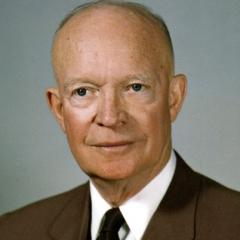
Dwight D. Eisenhower

English biography, 120-180 words more

You May Also Like

“More than ever before, in our country, this is the age of the individual. Endowed with the accumulated knowledge of centuries, armed with all the instruments of modern science, he is still assured personal freedom and wide avenues of expression so that he may win for himself, his family and his country greater material comfort, ease and happiness; greater spiritual satisfaction and contentment.”

“You must keep your honor! You can't speak for the country; you can do little about the national economy or actions of moral weaklings who excuse themselves with the expression, "That is politics; nor can you be responsible for deception in others. But you are responsible for yourself! There are no collective panaceas - only individual ones."”

“Rest enough for the individual man, too much and too soon, and we call it death. But for man, no rest and no ending. He must go on, conquest beyond conquest. First this little planet and all its winds and ways, and then all the laws of mind and matter that restrain him. Then the planets about him, and, at last, out across immensities to the stars. And when he has conquered all the deep space, and all the mysteries of time, still he will be beginning.”

“In later life, as in earlier, only a few persons influence the formation of our character; the multitude pass us by like a distant army. One friend, one teacher, one beloved, one club, one dining table, one work table are the means by which one's nation and the spirit of one's nation affect the individual.”

“An old Arabian fable tells of a prince imprisoned in a castle which had thirteen windows. Twelve of these windows overlooked lovely scenes, while the thirteenth looked down on the black ash heaps of the city. Ignoring the twelve windows, the prince always looked out through the thirteenth. It is so often true that whether a person carries with him an atmosphere of gloom and depression or one of confidence and courage depends on his individual outlook.”