Quotessence
Home / Quotes / Quote by Ernst Cassirer

Quote by Ernst Cassirer

“It was a long evolutionary course which the human mind had to traverse, to pass from the belief in a physico-magical power comprised in the Word to a realization of its spiritual power. Indeed, it is the Word, it is language, that really reveals to man that world which is closer to him than any world of natural objects and touches his weal and woe more directly than physical nature. For it is language that makes his existence in a community possible; and only in society, in relation to a "Thee", can his subjectivity assert itself as a "Me.”

Quote by Ernst Cassirer

Work

Language and Myth

This book delves into the intricate connections between the ways language is used and the stories that shape cultural mythologies. more

Author

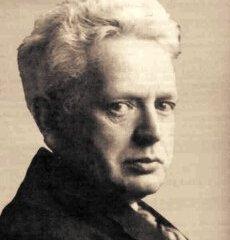
Ernst Cassirer
Ernst Cassirer

German philosopher, cultural philosopher, and one of the important representatives of phenomenology. Cassirer is renowned for his philosophical exploration of symbolic forms, particularly in the fields of language, art, and religion. His thoughts were deeply influenced by Kant, Hegel, and Husserl, and had a profound impact on 20th-century philosophy. more

You May Also Like

“All right," she said at last, "I get it. Societies establish their own value system, and once that system is in place, it becomes that society's own cage. It exists to feed itself, in an endless cycle of reconfirming its own arbitrary worth. Still, Adam, some undeniable truths lie at the core of those value systems. Specifically, we exist in a state of scarcity and imbalance, and most if not all of our mechanisms are devoted to managing both.”

“The heart is small, but it has the capacity to love infinite. Man is born with the potential to become an ocean of love. But few people attain to this innate potential. The society, the culture, the civilization, the politicians, the organized church, the priests and the vested interests are all against the individual. They sacrifice the individual for the sake of the collective, the unconscious masses. The collective does not need love, on the contrary the collective needs hate. The Christians have to hate the Mohammedans, because the collective can only remain together in hate. One country has to hate another country, otherwise it will fall apart.In times of war countries become united against a common enemy. When they donot have a common enemy they start fighting amongst themselves. The individual can grow only through love and the collective needs hate, so thereis a conflict between the interests of the individual and the interests of the collective  crowd, the collective mob. The individual has to be very aware not to be exploited by the unconscious crowd.Unless the individual is aware, you can lose the opportunity to grow, to become mature and to attain your innate potential in life.”

“Hypocrisy may be the acknowledgement of how one is falling short of one's objectives and ideal behavior but at other times hypocrisy may be the acknowledgement that one is not meeting the external standards of the systems and the society where they are trying to belong, to "fit in" and so may choose to hide aspects of their truest self. Different kind of hypocrisy. Can you recognize the difference? Can you feel the difference?”

“Her naiveté responded whole-heartedly to the expensive simplicity of the Divers, unaware of its complexity and its lack of innocence, unaware that it was all a selection of quality rather than quantity from the run of the world's bazaar; and that the simplicity of behavior also, the nursery-like peace and good will, the emphasis on the simpler virtues, was part of a desperate bargain with the gods and had been attained through struggles she could not have guessed at.”

“The 32 Society by Stewart Stafford Fight to the last piece, they said, Icons of state bring up the rear, Grunt pawn's first blood duty, Let the board's body count commence. Equine knight in dog-legged battle, Warrior bishop's angular support, Scorpion's claw pincer movement, Then, the trap slams mercilessly shut. The field wiped clean of combatants, The aristocracy's barren playground, Royals tour their chequered court, Pieces reassembled as war restarts. © Stewart Stafford, 2024. All rights reserved.”

“It is often asked: Why was capitalism destroyed in spite of its incomparably beneficent record? The answer lies in the fact that the lifeline feeding any social system is a culture’s dominant philosophy and that capitalism never had a philosophical base. It was the last and (theoretically) incomplete product of an Aristotelian influence. As a resurgent tide of mysticism engulfed philosophy in the nineteenth century, capitalism was left in an intellectual vacuum, its lifeline cut. Neither its moral nature nor even its political principles had ever been fully understood or defined. Its alleged defenders regarded it as compatible with government controls (i.e., government interference into the economy), ignoring the meaning and implications of the concept of laissez-faire. Thus, what existed in practice, in the nineteenth century, was not pure capitalism, but variously mixed economies. Since controls necessitate and breed further controls, it was the statist element of the mixtures that wrecked them; it was the free, capitalist element that took the blame.”