Quotessence
Home / Quotes / Quote by Abdul Kalam

Quote by Abdul Kalam

“Science has revealed that the human body is made up of millions and millions of atoms... For example, I am made up of 5.8x10^27 atoms.”

Quote by Abdul Kalam

Author
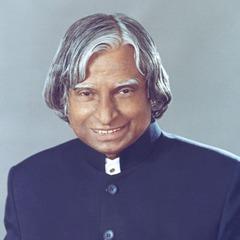
Abdul Kalam
Abdul Kalam

Dr. Abdul Kalam, born on October 15, 1931, and passed away on July 27, 2015, was a renowned physicist, engineer, and educator from India. He served as the 11th President of India. Kalam was instrumental in India's space program, often referred to as the 'Father of Indian Space Program'. more

You May Also Like

“Holding onto and manipulating physical objects is one of the things we learn earliest and do the most. It should not be surprising that object control is the basis of one of the five most fundamental metaphors for our inner life. To control objects, we must learn to control our bodies. We learn both forms of control together. Self-control and object control are inseparable experiences from earliest childhood. It is no surprise that we should have as a metaphor-a primary metaphor-Self Control is Object Control.”

“Engagement is the conscious inhabitation of your body and mind. Practice is happening when your open awareness is moving with, in and through your embodied activity. Intrinsic to practice is your conscious participation with your life. Engagement is the conduction of your free and open awareness through your activities, whatever they may be.”

“Now, since our condition accommodates things to itself, and transforms them according to itself, we no longer know things in their reality; for nothing comes to us that is not altered and falsified by our Senses. When the compass, the square, and the rule are untrue, all the calculations drawn from them, all the buildings erected by their measure, are of necessity also defective and out of plumb. The uncertainty of our senses renders uncertain everything that they produce.”

“We are mindful of desire when we experience it with an embodied awareness, recognizing the sensations and thoughts of wanting as arising and passing phenomena. While this isn't easy, as we cultivate the clear seeing and compassion of Radical Acceptance, we discover we can open fully to this natural force, and remain free in its midst.”

“Recent studies of mindfulness practices reveal that they can result in profound improvements in a range of physiological, mental, and interpersonal domains in our lives. Cardiac, endocrine, and immune functions are improved with mindfulness practices. Empathy, compassion, and interpersonal sensivity seem to be improved. People who come to develop the capacity to pay attention in the present moment without grasping on to their inevitable judgments also develop a deeper sense of well-being and what can be considered a form of mental coherence.”