Quotessence
Home / Quotes / Quote by Saint Basil

Quote by Saint Basil

“When someone steals another's clothes, we call them a thief. Should we not give the same name to one who could clothe the naked and does not? The bread in your cupboard belongs to the hungry; the coat unused in your closet belongs to the one who needs it; the shoes rotting in your closet belong to the one who has no shoes; the money which you hoard up belongs to the poor.”

Quote by Saint Basil

Author
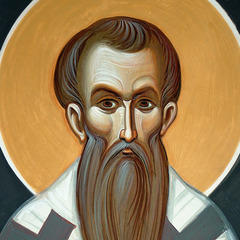
Saint Basil
Saint Basil

Saint Basil (330-379 AD) was a prominent theologian, monk, and church organizer in the early Christian Church. Born in Caesarea of Cappadocia, he was a member of the Basil family. Known for his strict monastic life and contributions to church organization, Saint Basil is celebrated for his reforms of church discipline and his influential writings on theology. more

You May Also Like

“When any relationship is characterized by difference, particularly a disparity in power, there remains a tendency to model it on the parent-child-relationship. Even protectiveness and benevolence toward the poor, toward minorities, and especially toward women have involved equating them with children.”

“We used to have a War Office, but now we have a Ministry of Defence, nuclear bombs are now described as deterrents, innocent civilians killed in war are now described as collateral damage and military incompetence leading to US bombers killing British soldiers is cosily described as friendly fire. Those who are in favour of peace are described as mavericks and troublemakers, whereas the real militants are those who want the war.”

“Sometime in your life, hope that you might see one starved man, the look on his face when the bread finally arrives. Hope that you might have baked it or bought or even kneaded it yourself. For that look on his face, for your meeting his eyes across a piece of bread, you might be willing to lose a lot, or suffer a lot, or die a little, even.”

“The followers of Christ have been called to peace. . . . And they must not only have peace but make it. And to that end they renounce all violence and tumult. In the cause of Christ nothing is to be gained by such methods . . . . His disciples keep the peace by choosing to endure suffering themselves rather than inflict it on others. They maintain fellowship where others would break it off. They renounce hatred and wrong. In so doing they overcome evil with good, and establish the peace of God in the midst of a world of war and hate.”