Quotessence
Home / Quotes / Quote by Gregory Palamas

Quote by Gregory Palamas

“... whenever Christ, the Bridegroom of pure souls, is mystically united with each soul, He gives the Father occasion to rejoice over this as at a wedding. It is Christ Himself Who says, 'Joy shall be in heaven over one sinner who repents' (Lk. 15:7). For joy, according to the Apostle, is the fruit of the Holy Spirit (Gal. 5:22), Who through conversion brings back to Christ those living in repentance, and reunites them with Him. And this joy embraces both those in heaven and godly men on earth. That is why there is joy in heaven over one repentant sinner.”

Quote by Gregory Palamas

Author
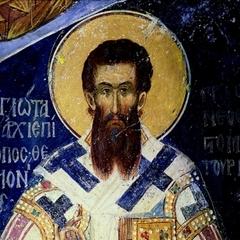
Gregory Palamas
Gregory Palamas

St. Gregory Palamas (1296-1359) was an influential Orthodox theologian and philosopher. He is known for his doctrine of the Uncreated Light, which had a profound impact on the development of Orthodox theology. more

You May Also Like

“Men seized of the urge to have a knowledge of God and to be pure in mind devote all their gathered energies to this one task. While they still live in the corruption of the flesh they give themselves to that service in which they will persevere when the corruption has been laid aside. And already they come in sight of what the Lord and Savior held out when He said, 'Blessed are the clean of heart, for they will see God' (Mt. 5:8).”

“The second request of the very pure soul is to see the coming of the Father's kingdom (cf. Mt. 6:10). What this means first of all is that each day Christ should reign among holy men. And this happens when the devil's power has been driven out of our hearts through the expulsion of sinful foulness and when God has begun to reign within us amid the good odors of virtue. With fornication vanquished, chastity rules; with anger overcome, peace is king; with pride under foot, humility is sovereign.”

“Our Lord Jesus Christ made the merciful shepherding of His sheep the proof of love for Himself (cf. Jn. 21:15-17). He denounces as 'wicked' the servant who refused to pardon the debt of his fellow servant and who did not share in even the smallest way, the immense kindness that was bestowed on himself; that he should suffer the fate which he dealt is plainly shown to be right (cf. Mt. 18:32-33).”

“Anyone who has fallen into fornication, adultery or any other such bodily impurity, should desist from this revolting filth and cleanse himself through confession, tears, fasting and the like. For God judges unrepentant fornicators and adulterers. He condemns them, dismisses them and consigns them to hell, unquenchable fire and other never-ending punishments, saying, 'Let the impure and accursed be taken away, lest they see and enjoy the glory of the Lord' (cf. Isa. 26:10 LXX).”

“The Son is 'Life' (Jn. 14:6) because He is 'Light', constituting and giving reality to every thinking being. 'For in Him we live, move and exist' (Acts 17:28) and there is a two-fold sense in which He breathes into us (cf. Gen. 2:7; Jn. 20:22); we are filled, all of us, with His breath, and those who are capable of it, all those who open their mind's mouth wide enough, with His Holy Spirit.”

“It is only all too easy to understand the requirements contained in God's Word ('Give all your goods to the poor.' 'If anyone strikes you on the right cheek, turn the left.' 'If anyone takes your coat, let him have your cloak also. Rejoice always.' 'Count it sheer joy when you meet various temptations' etc.). The most ignorant, poor creature cannot honestly deny being able to understand God's requirements. But it is tough on the flesh to will to understand it and to then act accordingly. It is not a question of interpretation, but action.”

“Our starting-point must be the fact that God cannot be named... no mind has yet contained or language embraced God's substance in its fullness. No, we use facts connected with Him to outline qualities that correspond with Him, collecting a faint and feeble mental image from various quarters. Our noblest theologian is not one who has discovered the whole - our earthly shackles do not permit us the whole - but one whose mental image is by comparison fuller, who has gathered in his mind a richer picture, outline, or whatever we call it, of the truth.”