Quotessence
Home / Quotes / Quote by Hermann Hesse

Quote by Hermann Hesse

“It is wrong to say that schoolmasters lack heart and are dried-up, soulless pedants! No, by no means. When a child's talent which he has sought to kindle suddenly bursts forth, when the boy puts aside his wooden sword, slingshot, bow-and-arrow and other childish games, when he begins to forge ahead, when the seriousness of the work begins to transform the rough-neck into a delicate, serious and an almost ascetic creature, when his face takes on an intelligent, deeper and more purposeful expression - then a teacher's heart laughs with happiness and pride. It is his duty and responsibility to control the raw energies and desires of his charges and replace them with calmer, more moderate ideals. What would many happy citizens and trustworthy officials have become but unruly, stormy innovators and dreamers of useless dreams, if not for the effort of their schools? In young beings there is something wild, ungovernable, uncultured which first has to be tamed. It is like a dangerous flame that has to be controlled or it will destroy. Natural man is unpredictable, opaque, dangerous, like a torrent cascading out of uncharted mountains. At the start, his soul is a jungle without paths or order. And, like a jungle, it must first be cleared and its growth thwarted. Thus it is the school's task to subdue and control man with force and make him a useful member of society, to kindle those qualities in him whose development will bring him to triumphant completion.”

Quote by Hermann Hesse

Work

Beneath the Wheel

Browse quotes and source details for this work. more

Author
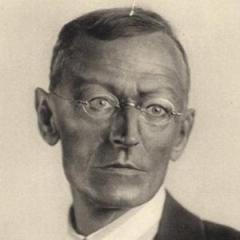
Hermann Hesse
Hermann Hesse

Hermann Hesse was a German poet and novelist, born on July 2, 1877, and died on August 9, 1962. Known for his profound psychological descriptions and exploration of human nature, his works include classics such as 'Steppenwolf' and 'The Glass Bead Game'. more

You May Also Like

“Knightley Academy stood out against the moonlight in silhouette, a ramshackle collection of chimneys, turrets and gables. Both boys stopped to take in the sight of the manicured lawns and tangled woods, the soaring chapel and the ivy-covered brick of the headmaster's house. They were home. For this, Henry felt, was home. Not some foreign castle encircled by guard towers, but this cozy, bizarre assortment of buildings with its gossiping kitchen maids and eccentric professors and clever students.”

“Rose's work of art took her all day, including two playtimes, story time, and most of lunch. At the end of school it was stolen from her by the wicked teacher who had pretended to be so interested. "Beautiful- what-is-it?" she asked as she pinned it high on the wall, where Rose could not reach. "They take your pictures," said Indigo,... when he finally made out what all the roaring and stamping was about. "They do take them.... Why do you want that picture so much?" he asked Rose. "It was my best ever," said Rose furiously. "I hate school. I hate everyone in it. I will kill them all when I'm big enough." "You can't just go round killing people," Indigo told her...”

“The house-cat is a four-legged quadruped, the legs as usual being at the corners. It is what is sometimes called a tame animal, though it feeds on mice and birds of prey. Its colours are striped, it does not bark, but breathes through its nose instead of its mouth. Cats also mow, which you all have heard. Cats have nine liveses, but which is seldom wanted in this country, coz' of Christianity. Cats eat meat and most anythink speshuelly where you can't afford. That is all about cats." (From a schoolboy's essay, 1903.)”

“It facilitates labor and thought so much that there is always the temptation in large schools to omit the endless task of meeting the wants of each single mind, and to govern by steam. But it is at frightful cost. Our modes of Education aim to expedite, to save labor; to do for masses what cannot be done for masses, what must be done reverently, one by one: say rather, the whole world is needed for the tuition of each pupil.”

“It was 1976. It was one of the darkest days of my life when that nurse, Mrs. Shimmer, pulled out a maxi pad that measured the width and depth of a mattress and showed us how to use it. It had a belt with it that looked like a slingshot that possessed the jaw-dropping potential to pop a man's head like a gourd. As she stretched the belt between the fingers of her two hands, Mrs. Shimmer told us becoming a woman was a magical and beautiful experience. I remember thinking to myself, You're damn right it had better be magic, because that's what it's going to take to get me to wear something like that, Tinkerbell! It looked like a saddle. Weighed as much as one, too. Some girls even cried. I didn't. I raised my hand. "Mrs. Shimmer," I asked the cautiously, "so what kind of security napkins do boys wear when their flower pollinates? Does it have a belt, too?" The room got quiet except for a bubbling round of giggles. "You haven't been paying attention, have you?" Mrs. Shimmer accused sharply. "Boys have stamens, and stamens do not require sanitary napkins. They require self control, but you'll learn that soon enough." I was certainly hoping my naughty bits (what Mrs. Shimmer explained to us was like the pistil of a flower) didn't get out of control, because I had no idea what to do if they did.”