Quotessence
Home / Quotes / Quote by Thomas Mann

Quote by Thomas Mann

“We are the bourgeoisie—the third estate, as they call us now—and what we want is a nobility of merit, nothing more. We don't recognize this lazy nobility we now have, we reject our present class hierarchy. We want all men to be free and equal, for no one to be someone else's subject, but for all to be subject to the law. There should be an end of privileges and arbitrary power. Everyone should be treated equally as a child of the state, and just as there are no longer any middlemen between the layman and his God, so each citizen should stand in direct relation to the state. We want freedom of the press, of employment, of commerce. We want all men to compete without any special privileges, and the only crown should be the crown of merit.”

Quote by Thomas Mann

Work

Buddenbrooks: The Decline of a Family

Browse quotes and source details for this work. more

Author
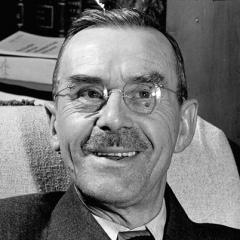
Thomas Mann
Thomas Mann

Thomas Mann, born on June 6, 1875, and died on August 12, 1955, was a German novelist and one of the greatest writers of the 20th century. Known for his profound psychological portrayals and rich imagination, his works extensively covered themes such as individual and society, history and reality. His masterpieces include 'Buddenbrooks' and 'The Magic Mountain'. more

You May Also Like

“What imperialists actually wanted was expansion of political power without the foundation of the body politic. Imperialist expansion had been touched off by a curious kind of economic crisis, the overproduction of capital and the emergence of "superfluous" money, the result of oversaving, which could no longer find productive investment within national borders. For the first time, investment of power did not pave the way for investment of money, since uncontrollable investments in distant countries threatened to transform large strata of society into gamblers, to change the whole capitalist economy from a system of production to a system of financial speculation, and to replace the profits of production with profits in commissions. The decade immediately before the imperialist era, the seventies of the last century, witnessed an unparalleled increase in swindles, financial scandals, and gambling in the stock market.”

“Darwinism met with such overwhelming success because it provided, on the basis of inheritance, the ideological weapons for race and well as class rule and could be used for, as well as against, race discrimination. Politically speaking, Darwinism as such was neutral, and it has led, indeed, to all kinds of pacifism and cosmopolitanism as well as to the sharpest forms of imperialistic ideologies. In the seventies and eighties of the last century, Darwinism was still almost exclusively in the hands of the utilitarian anti-colonial party in England. And the first philosopher of evolution, Herbert Spencer, who treated sociology as part of biology, believed natural selection to benefit the evolution of mankind and to result in everlasting peace. For political discussion, Darwinism offered two important concepts: the struggle for existence with optimistic assertion of the necessary and automatic "survival of the fittest," and the indefinite possibilities which seemed to lie in the evolution of man out of animal life and which started the new "science" of eugenics.”

“The philosophy of Hobbes, it is true, contains nothing of modern race doctrines, which not only stir up the mob, but in their totalitarian form outline very clearly the forms of organization through which humanity could carry the prerequisite for all race doctrines, that is, the exclusion in principle of the idea of humanity which constitutes the sole regulating idea of international law. With the assumption that foreign politics is necessarily outside of the human contract, engaged in the perpetual war of all against all, which is the law of the "state of nature," Hobbes affords the best possible theoretical foundation for those naturalistic ideologies which hold nations to be tribes, separated from each other by nature, without any connection whatever, unconscious of the solidarity of mankind and having in common only the instinct for self-preservation which man shares with the animal world. If the idea of humanity, of which the most conclusive symbol is the common origin of the human species, is no longer valid, then nothing is more plausible than a theory according to which brown, yellow, or black races are descended from some other species of apes than the white race, and that all together are predestined by nature to war against each other until they have disappeared from the face of the earth.”

“It is significant that modern believers in power are in complete accord with the philosophy of the only great thinker who ever attempted to derive public good from private interest and who, for the sake of private good, conceived and outlined a Commonwealth whose basis and ultimate end is the accumulation of power. Hobbes, indeed, is the only great philosopher to whom the bourgeoisie can rightly and exclusively lay claim.... .... The consistency of this conclusion is in no way altered by the remarkable fact that for some three hundred years there was neither a sovereign who would "convert this Truth of Speculation into the Utility of Practice," nor a bourgeoisie politically conscious and economically mature enough openly to adopt Hobbes's philosophy of power.”