“Can the difficulty of an exam be measured by how many bits of information a student would need to pass it? This may not be so absurd in the encyclopedic subjects but in mathematics it doesn't make any sense since things follow from each other and, in principle, whoever knows the bases knows everything. All of the results of a mathematical theorem are in the axioms of mathematics in embryonic form, aren't they?”
Quote by Alfred Renyi
Work
A diary on information theory
This book delves into the evolution of information theory, providing a detailed account of its core ideas and their impact on various fields. It covers the historical context, key figures, and the mathematical underpinnings of the discipline. more
Author
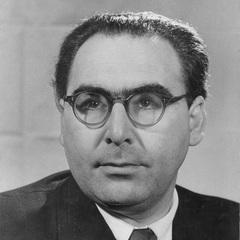
Alfred Renyi
Alfred Rényi was an outstanding mathematician known for his contributions to probability theory, combinatorics, and graph theory. He was born on March 20, 1921, and passed away on February 1, 1970. more
You May Also Like
Source: The Works of Alexander Pope, Esq., with Notes and Illustrations, by Himself and Others. To which are Added, a New Life of the Author, an Estimate of His Poetical Character and Writings, and Occasional Remarks by William Roscoe, Esq
Source: Five complete Miss Marple novels
“The solution "cost me study that robbed me of rest for an entire night."”
“In mathematics, the art of asking questions is more valuable than solving problems.”
Source: Agatha Christie: An Autobiography