Quotessence
Home / Quotes / Quote by Agatha Christie

Quote by Agatha Christie

“I continued to do arithmetic with my father, passing proudly through fractions to decimals. I eventually arrived at the point where so many cows ate so much grass, and tanks filled with water in so many hours. I found it quite enthralling.”

Quote by Agatha Christie

Work

Agatha Christie: An Autobiography

Agatha Christie: An Autobiography is a candid look into the life of the famous British author. The book covers her early years, her writing career, and personal anecdotes, providing a comprehensive view of her life and the factors that influenced her work. more

Author
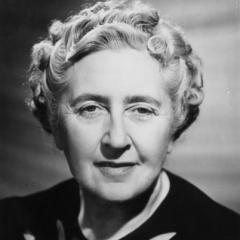
Agatha Christie
Agatha Christie

Agatha Christie, a renowned British detective novel writer, is known as the Queen of Detective Fiction. She was born on September 15, 1890, and passed away on January 12, 1976. Christie's works are characterized by intricate plots, unique reasoning, and vivid characters, and have had a profound impact on detective fiction worldwide. more

You May Also Like

“How then shall mathematical concepts be judged? They shall not be judged. Mathematics is the supreme arbiter. From its decisions there is no appeal. We cannot change the rules of the game, we cannot ascertain whether the game is fair. We can only study the player at his game; not, however, with the detached attitude of a bystander, for we are watching our own minds at play.”

“Mathematical thinking is not the same as doing mathematics - at least not as mathematics is typically presented in our school system. School math typically focuses on learning procedures to solve highly stereotyped problems. Professional mathematicians think a certain way to solve real problems, problems that can arise from the everyday world, or from science, or from within mathematics itself. The key to success in school math is to learn to think inside-the-box. In contrast, a key feature of mathematical thinking is thinking outside-the-box - a valuable ability in today's world.”

“What makes it possible to learn advanced math fairly quickly is that the human brain is capable of learning to follow a given set of rules without understanding them, and apply them in an intelligent and useful fashion. Given sufficient practice, the brain eventually discovers (or creates) meaning in what began as a meaningless game.”

“I soon found an opportunity to be introduced to a famous professor Johann Bernoulli. ... True, he was very busy and so refused flatly to give me private lessons; but he gave me much more valuable advice to start reading more difficult mathematical books on my own and to study them as diligently as I could; if I came across some obstacle or difficulty, I was given permission to visit him freely every Sunday afternoon and he kindly explained to me everything I could not understand.”

“Notable enough, however, are the controversies over the series 1 - 1 + 1 - 1 + 1 - ... whose sum was given by Leibniz as 1/2, although others disagree. ... Understanding of this question is to be sought in the word "sum"; this idea, if thus conceived - namely, the sum of a series is said to be that quantity to which it is brought closer as more terms of the series are taken - has relevance only for convergent series, and we should in general give up the idea of sum for divergent series.”

“The kind of knowledge which is supported only by observations and is not yet proved must be carefully distinguished from the truth; it is gained by induction, as we usually say. Yet we have seen cases in which mere induction led to error. Therefore, we should take great care not to accept as true such properties of the numbers which we have discovered by observation and which are supported by induction alone. Indeed, we should use such a discovery as an opportunity to investigate more exactly the properties discovered and to prove or disprove them; in both cases we may learn something useful.”

“Imagine that you wanted your children to learn the names of all their cousins, aunts and uncles. But you never actually let them meet or play with them. You just showed them pictures of them, and told them to memorize their names. Each day you'd have them recite the names, over and over again. You'd say, "OK, this is a picture of your great-aunt Beatrice. Her husband was your great-uncle Earnie. They had three children, your uncles Harpo, Zeppo, and Gummo. Harpo married your aunt Leonie ... yadda, yadda, yadda."”