Quotessence
Home / Quotes / Quote by George R. R. Martin

Quote by George R. R. Martin

“I get up every day and work in the morning. I have my coffee and get to work. On good days I look up and it's dark outside and the whole day has gone by and I don't know where it's gone. But there's bad days, too. Where I struggle and sweat and a half hour creeps by and I've written three words. And half a day creeps by and I've written a sentence and a half and then I quit for the day and play computer games. You know, sometimes you eat the bear and sometimes the bear eats you. [Laughs]”

Quote by George R. R. Martin

Author
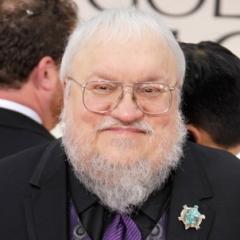
George R. R. Martin
George R. R. Martin

George R. R. Martin is an American novelist, best known for his epic fantasy works, particularly the 'A Song of Ice and Fire' series. His novels have gained widespread acclaim for their rich world-building, complex characters, and gripping narrative. The series has been adapted into the popular television show 'Game of Thrones'. more

You May Also Like

“I don't like the strictly objective viewpoint [in which all of the characters' actions are described in the third person, but we never hear what any of them are thinking.] Which is much more of a cinematic technique. Something written in third person objective is what the camera sees. Because unless you're doing a voiceover, which is tremendously clumsy, you can't hear the ideas of characters. For that, we depend on subtle clues that the directors put in and that the actors supply. I can actually write, "'Yes you can trust me,' he lied." [But it's better to get inside the characters' heads.]”

“Susan Lucci was the biggest star in the daytime galaxy, and she served it up hot and fresh and chic five days a week. Before there was Joan Collins's Alexis Morrell Carrington Colby Dexter Rowan on 'Dynasty,' there was Erica Kane Martin Brent Cudahy Chandler Montgomery Montgomery Chandler Marick Marick Montgomery on 'All My Children.'”

“In order to get inside their skin, I have to identify with them. That includes even the ones who are complete bastards, nasty, twisted, deeply flawed human beings with serious psychological problems. Even them. When I get inside their skin and look out through their eyes, I have to feel a certain - if not sympathy, certainly empathy for them. I have to try to perceive the world as they do, and that creates a certain amount of affection.”

“All fiction, if it's successful, is going to appeal to the emotions. Emotion is really what fiction is all about. That's not to say fiction can't be thoughtful, or present some interesting or provocative ideas to make us think. But if you want to present an intellectual argument, nonfiction is a better tool. You can drive a nail with a shoe but a hammer is a better tool for that. But fiction is about emotional resonance, about making us feel things on a primal and visceral level.”

“I'm a strong believer in telling stories through a limited but very tight third person point of view. I have used other techniques during my career, like the first person or the omniscient view point, but I actually hate the omniscient viewpoint. None of us have an omniscient viewpoint; we are alone in the universe. We hear what we can hear... we are very limited. If a plane crashes behind you I would see it but you wouldn't. That's the way we perceive the world and I want to put my readers in the head of my characters.”

“From where I sit, battles are hard. I’ve written my share. Sometimes I employ the private’s viewpoint, very up close and personal, dropping the reader right into the middle of the carnage. That’s vivid and visceral, but of necessity chaotic, and it is easy to lose all sense of the battle as a whole. Sometimes I go with the general’s point of view instead, looking down from on high, seeing lines and flanks and reserves. That gives a great sense of the tactics, of how the battle is won or lost, but can easily slide into abstraction.”