Quotessence
Home / Quotes / Quote by Lee Kuan Yew

Quote by Lee Kuan Yew

“I am often accused of interfering in the private lives of citizens. Yes, if I did not, had I not done that, we wouldn't be here today. And I say without the slightest remorse, that we wouldn't be here, we would not have made economic progress, if we had not intervened on very personal matters - who your neighbour is, how you live, the noise you make, how you spit, or what language you use. We decide what is right. Never mind what the people think.”

Quote by Lee Kuan Yew

Author
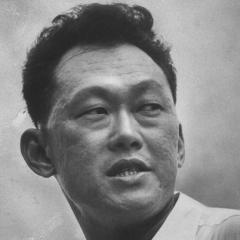
Lee Kuan Yew
Lee Kuan Yew

Lee Kuan Yew was the founding father of Singapore, a politician, lawyer, and statesman. Born on September 16, 1923, in Singapore, he played a crucial role in transforming the city-state from a small fishing village into a global financial hub and trading center. He served as the first Prime Minister of Singapore after its independence in 1965 and continued in the role until his retirement in 1990. Lee Kuan Yew passed away on March 23, 2015. more

You May Also Like

“Mine is a very matter-of-fact approach to the problem. If you can select a population and they're educated and they're properly brought up, then you don't have to use too much of the stick because they would already have been trained. It's like with dogs. You train it in a proper way from small. It will know that it's got to leave, go outside to pee and to defecate. No, we are not that kind of society. We had to train adult dogs who even today deliberately urinate in the lifts.”

“Keynes was a great economist. In every discipline, progress comes from people who make hypotheses, most of which turn out to be wrong, but all of which ultimately point to the right answer. Now Keynes, in 'The General Theory of Employment, Interest and Money,' set forth a hypothesis which was a beautiful one, and it really altered the shape of economics. But it turned out that it was a wrong hypothesis. That doesn't mean that he wasn't a great man!”

“Our minds tell us, and history confirms, that the great threat to freedom is the concentration of power. Government is necessary to preserve our freedom, it is an instrument through which we can exercise our freedom; yet by concentrating power in political hands, it is also a threat to freedom. Even though the men who wield this power initially be of good will and even though they be not corrupted by the power they exercise, the power will both attract and form men of a different stamp.”

“Political freedom means the absence of coercion of a man by his fellow men. The fundamental threat to freedom is power to coerce, be it in the hands of a monarch, a dictator, an oligarchy, or a momentary majority. The preservation of freedom requires the elimination of such concentration of power to the fullest possible extent and the dispersal and distribution of whatever power cannot be eliminated — a system of checks and balances.”

“The key insight of Adam Smith's Wealth of Nations is misleadingly simple: if an exchange between two parties is voluntary, it will not take place unless both believe they will benefit from it. Most economic fallacies derive from the neglect of this simple insight, from the tendency to assume that there is a fixed pie, that one party can gain only at the expense of another.”