Quotessence
Home / Quotes / Quote by Steven Pinker

Quote by Steven Pinker

“An endorsement of scientific thinking must first of all be distinguished from any belief that members of the occupational guild called 'science' are particularly wise or noble. The culture of science is based on the opposite belief -- its signature practices (including open debate, peer review, and double-blind methods) are designed to circumvent the sins to which scientists, being human, are vulnerable. As Richard Feynman put it, 'the first principle (of science) is that you must not fool yourself and you are the easiest person to fool.”

Quote by Steven Pinker

Work

Author

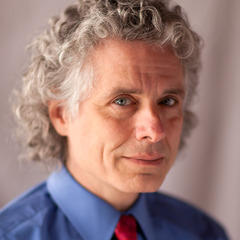
Steven Pinker
Steven Pinker

Steven Pinker is a renowned cognitive psychologist, linguist, and author. His research focuses on language, cognition, and human behavior, particularly the relationship between language and thought. Pinker is known for his in-depth research on the evolution of language and his contributions to the field of cognitive science. more

You May Also Like

“Also, I say that although things other than God are actually contingent as regards their actual existence, this is not true with regard to potential existence. Wherefore, those things which are said to be contingent with reference to actual existence are necessary with respect to potential existence. Thus, though "Man exists" is contingent, "It is possible for man to exist" is necessary, because it does not include a contradiction as regards existence. For, for something other than God to be possible, then, is necessary. Being is divided into what must exist and what can but need not be. And just as necessity is of the very essence or constitution of what must be, so possibility is of the very essence of what can but need not be. Therefore, let the former argument be couched in terms of possible being and the propositions will become necessary. Thus: It is possible that something other than God exist which neither exists of itself (for then it would not be possible being) nor exists by reason of nothing. Therefore, it can exist by reason of another. Either this other can both exist and act in virtue of itself and not in virtue of another, or it cannot do so. If it can, then it can be the first cause, and if it can exist, it does exist—as was proved above. If it cannot [both be and act independently of every other thing] and there is no infinite regress, then at some point we end up [with a first cause].”

“Все французы-мужчины знают что нужно стать цивилизованным между восемнадцатью и двадцатью тремя и что цивилизация приходит к вам через отношения с женщинами постарше, через революцию, через военную дисциплину, через побег откуда-нибудь или через подчинение кому-нибудь, после чего вы стали цивилизованным и жизнь идет как надо на латинский лад, жизнь умиротворяющая и интригующая, вот теперь жизнь цивилизованна, логична и модна короче говоря жизнь как жизнь.”

“Thus Milton refines the question down to a matter of faith," said Coleridge, bringing the lecture to a close, "and a kind of faith more independent, autonomous - more truly strong, as a matter of fact - than the Puritans really sought. Faith, he tells us, is not an exotic bloom to be laboriously maintained by the exclusion of most aspects of the day to day world, nor a useful delusion to be supported by sophistries and half-truths like a child's belief in Father Christmas - not, in short, a prudently unregarded adherence to a constructed creed; but rather must be, if anything, a clear-eyed recognition of the patterns and tendencies, to be found in every piece of the world's fabric, which are the lineaments of God. This is why religion can only be advice and clarification, and cannot carry any spurs of enforcement - for only belief and behavior that is independently arrived at, and then chosen, can be praised or blamed. This being the case, it can be seen as a criminal abridgement of a person's rights willfully to keep him in ignorance of any facts - no piece can be judged inadmissible, for the more stones, both bright and dark, that are added to the mosaic, the clearer is our picture of God.”

“Almost immediately, reality gave ground on more than one point. The truth is that it hankered to give ground. Ten years ago, any symmetrical system whatsoever which gave the appearance of order–dialectical materialism, anti-Semitism, Nazism–was enough to fascinate men. Why not fall under the spell of Tlön and submit to the minute and vast evidence of an ordered planet? Useless to reply that reality, too, is ordered. It may be so, but in accordance with divine laws–I translate: inhuman laws–which we will never completely perceive. Tlön may be a labyrinth, but it is a labyrinth plotted by men, a labyrinth destined to be deciphered by men. Contact with Tlön and the ways of Tlön have disintegrated this world. Captivated by its discipline, humanity forgets and goes on forgetting that it is the discipline of chess players, not of angels.”