Quotessence
Home / Quotes / Quote by Gerhard Richter

Quote by Gerhard Richter

“It was not possible for us to produce the same optimism and the same kind of humour or irony. Actually, it was not irony. Lichtenstein is not ironic but he does have a special kind of humour. That's how I could describe it: humour and optimism. For Polke and me, everything was more fragmented. But how it was broken up is hard to describe.”

Quote by Gerhard Richter

Author
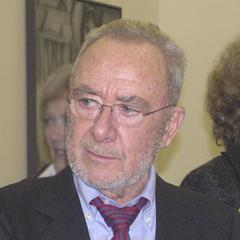
Gerhard Richter
Gerhard Richter

German visual artist known for his unique painting style and diverse creative techniques. Richter's works span a wide range of styles from abstraction to figuration, and his career has spanned over half a century, profoundly influencing contemporary art. more

You May Also Like

“A student researching into my work has actually traced the newspapers and magazines where I found theses images and has found out that many of them illustrate a collection of gruesome stories, murders and suicides which contrast with the images used. There is a contrast between the message carried by the text and that suppressed by the illustration.”

“But my motivation was more a matter of wanting to create order - to keep track of things. All those boxes full of photographs and sketches weigh you down, because they have something unfinished, incomplete, about them. So it's better to present the usable material in an orderly fashion and throw the other stuff away. That's how the Atlas came to be, and I exhibited it a few times.”

“In the beginning I tried to accommodate everything there that was somewhere between art and garbage and that somehow seemed important to me and a pity to throw away. After a while, some sheets in the Atlas acquired another value, after all - that is, it seemed to me that they could stand on their own terms, not only under the protection of the Atlas.”

“Composition is a side issue. Its role in my selection of photographs is a negative one at best. By which I mean that the fascination of a photograph is not in its eccentric composition but in what it has to say: its information content. And, on the other hand, composition always also has its own fortuitous rightness.”

“This superficial blurring has something to do with the incapacity I have just mentioned. I can make no statement about reality clearer than my own relationship to reality; and this has a great deal to do with imprecision, uncertainty, transience, incompleteness, or whatever. But this doesn't explain the pictures. At best it explains what led to their being painted.”