Quotessence
Home / Quotes / Quote by John Dewey

Quote by John Dewey

“Education Proceeds ultimately from the patterns furnished by institutions, customs, and laws- If the patterns of institutions, customs, and laws are broken for this philosophy education should fix itself. There should be several different things taught instead of one "Supreme Factor".”

Quote by John Dewey

Author
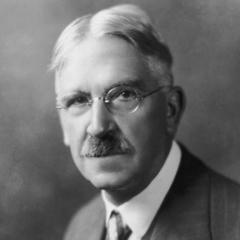
John Dewey
John Dewey

John Dewey was an American philosopher and educator, born on October 20, 1859, and died on June 1, 1952. He was a leading figure in the philosophy of pragmatism and had a profound impact on 20th-century education, philosophy, and the social sciences. more

You May Also Like

“Each generation is inclined to educate its young so as to get along in the present world instead of with a view to the proper end of education: the promotion of the best possible realization of humanity as humanity. Parents educate their children so that they may get on; princes educate their subjects as instruments of their own purpose.”

“A society which makes provision for participation in its good of all its members on equal terms and which secures flexible readjustment of its institutions through interaction of the different forms of associated life is in so far democratic. Such a society must have a type of education which gives individuals a personal interest in social relationships and control, and the habits of mind which secure social changes without introducing disorder.”

“It may be seriously questioned whether the philosophies... which isolate mind and set it over against the world did not have their origin in the fact that the reflective or theoretical class of men elaborated a large stock of ideas which social conditions did not allow them to act upon and test. Consequently men were thrown back into their own thoughts as ends in themselves.”

“Knowledge is humanistic in quality not because it is about human products in the past, but because of what it does in liberating human intelligence and human sympathy. Any subject matter which accomplishes this result is humane, and any subject matter which does not accomplish it is not even educational.”

“The premium so often put in schools upon external "discipline," and upon marks and rewards, upon promotion and keeping back, are the obverse of the lack of attention given to life situations in which the meaning of facts, ideas, principles, and problems is vitally brought home.”

“Various epochs of the past have had their own characteristic struggles and interests. Each of these great epochs has left behind itself a kind of cultural deposit, like a geologic stratum. These deposits have found their way into educational institutions in the form of studies, distinct courses of study, distinct types of schools.”