Quotessence
Home / Quotes / Quote by John Dewey

Quote by John Dewey

Work

The Political Writings

This volume compiles a selection of political writings that delve into the intricacies of political systems, ideologies, and the principles that govern them. The authors provide insights into the historical context and contemporary issues surrounding political theory and practice. more

Author
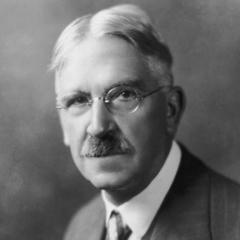
John Dewey
John Dewey

John Dewey was an American philosopher and educator, born on October 20, 1859, and died on June 1, 1952. He was a leading figure in the philosophy of pragmatism and had a profound impact on 20th-century education, philosophy, and the social sciences. more

You May Also Like

“It may be seriously questioned whether the philosophies... which isolate mind and set it over against the world did not have their origin in the fact that the reflective or theoretical class of men elaborated a large stock of ideas which social conditions did not allow them to act upon and test. Consequently men were thrown back into their own thoughts as ends in themselves.”

“Knowledge is humanistic in quality not because it is about human products in the past, but because of what it does in liberating human intelligence and human sympathy. Any subject matter which accomplishes this result is humane, and any subject matter which does not accomplish it is not even educational.”

“The premium so often put in schools upon external "discipline," and upon marks and rewards, upon promotion and keeping back, are the obverse of the lack of attention given to life situations in which the meaning of facts, ideas, principles, and problems is vitally brought home.”

“Various epochs of the past have had their own characteristic struggles and interests. Each of these great epochs has left behind itself a kind of cultural deposit, like a geologic stratum. These deposits have found their way into educational institutions in the form of studies, distinct courses of study, distinct types of schools.”

“The problem of education in a democratic society is to do away with ... dualism and to construct a course of studies which makes thought a guide of free practice for all and which makes leisure a reward of accepting responsibility for service, rather than a state of exemption from it.”

“The development of science has produced an industrial revolution which has brought different peoples in such close contact with one another through colonization and commerce that no matter how some nations may still look down upon others, no country can harbor the illusion that its career is decided wholly within itself.”

“When we consider the close connection between science and industrial development on the one hand, and between literary and aesthetic cultivation and an aristocratic social organization on the other, we get light on the opposition between technical scientific studies and refining literary studies. We have before us the need of overcoming this separation in education if society is to be truly democratic.”